
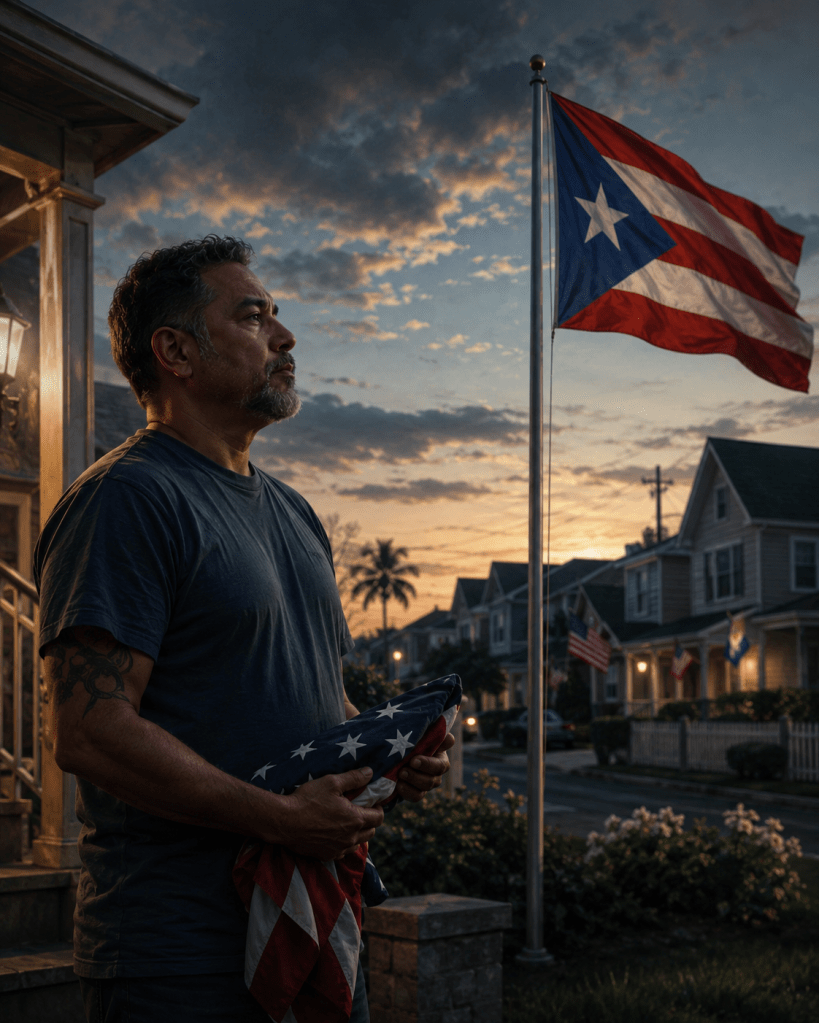
The Day I Took Down My American Flag
I used to fly the American flag in front of my house without thinking twice about it. For years, it felt like a simple expression of where I live and what I thought I believed about this country. I would see that red, white, and blue waving in the wind and connect it, almost automatically, to certain ideals. Democracy, service, sacrifice, opportunity. It was a habit, like most things people call patriotism.
I did not question it. The flag was just there, part of the background of my life. It blended in with all the other flags in the neighborhood, the ones you see on porches every summer and every national holiday. It felt safe, familiar, and unremarkable.
Then, slowly, that feeling started to change.
As the United States moves toward its 250th anniversary in 2026, the distance between what we say the flag represents and what I see around me has grown too wide to ignore. The country feels less like a shared project and more like a battlefield of competing identities. Minority communities, including Black Americans, Latinos, LGBTQ+ people, immigrants, and women, keep getting treated as bargaining chips or targets instead of full citizens. The country does not feel united. It feels brittle, angry, and deeply divided.
In that climate, the American flag on my porch stopped feeling like pride and started feeling like a costume that no longer fit.
One day, I quietly took it down.
I did not leave the pole empty. I walked into my garage, grabbed the Puerto Rican flag that had hung there for years, and raised it in front of my house.
I was not trying to start a culture war or make a dramatic political statement to my neighbors. This was not about trying to win an argument with anyone on one side or another. It was personal. I was leaning into my Puerto Rican heritage, into my history and lineage, because in this moment that identity feels more honest and more grounding than any version of American patriotism I can claim.
For nearly a decade, that same flag had hung in my open garage where neighbors, delivery drivers, and people walking by could see it. No one ever asked about it. No one ever commented. It was simply part of the background of my life. The moment I moved it from the garage to the front yard, it suddenly became a question.
When a Flag Becomes a Question
My next door neighbor was the first to reach out. She is kind, friendly, and a Trump supporter. We have always had cordial interactions, even if we live in very different political universes. She sent me a text message and asked, “What flag is that you are displaying?”
I was taken aback. In this neighborhood, you can see many different kinds of flags. There are American flags, college flags, sports teams, seasonal banners, and all sorts of other decorations. None of those seem to require an explanation. My flag did.
What struck me most was not new information, but what it revealed. I have known for years that she has visited Puerto Rico. We have lived near each other for a long time, and we had talked about her trip before. She has stood on the island, enjoyed the beaches, and taken in the views. She has physically been in our space. Yet when she saw the flag on my porch, it still did not register with her. The symbol of a place she once chose as a destination was unfamiliar enough that she felt the need to ask what it was.
Then there is my neighbor across the street. He is a good person. We always say hello and keep things friendly, but our conversations are brief. He saw the flag and recognized it right away as the Puerto Rican flag. Then he connected it to a Puerto Rican team in a World Cup event taking place in California.
Puerto Rico is not in any World Cup tournament in California.
I let that pass and explained gently. It struck me that even when people do recognize the flag, they often know it only in passing. They connect it to entertainment, to sports, or to some vague sense of a “Latin” identity that they cannot clearly describe. It is partial recognition without understanding.
In both interactions, what stood out was not hostility. It was the speed with which a Puerto Rican flag, even though Puerto Ricans are U.S. citizens, became something that needed to be questioned, identified, and explained, in a neighborhood where American flags are assumed to belong without comment.
Down the block, two houses face each other. One flies a Trump flag. The other flies a Pride flag. That small scene captures the country at 250 years. Flags become declarations in an ongoing culture war. I did not put up my Puerto Rican flag to pick a side in that particular fight. I put it up because my Puerto Rican identity is what I trust right now. In that choice, I realized again how little this country truly lives up to the word “united.”
The Racism We Do Not Talk About
This experience pushed me back to a theme I have written about before. There is a form of racism that we rarely name directly.
When people in the United States hear the word racism, many imagine the most obvious examples. They think of racial slurs, hate groups, or explicit violence. Those things are real and serious, but they are not the only form. There is another kind that is quieter and more socially acceptable. It appears in assumptions about who is normal and who is treated as an exception. It shows up in who is asked to explain themselves and who is never questioned. It is present in what we are expected to know and what we are allowed to ignore.
That is the kind of racism that asks my flag to justify itself while other flags pass as ordinary and unquestioned.
My neighbors are not villains in this story. They are not burning crosses and they are not yelling insults on the street. They are everyday people trying to live their lives. Their reactions are still part of a larger pattern. Puerto Rico often appears in the American imagination as a place to visit on vacation, as a team in a sporting event, or as a location in a weather report during hurricane season. It does not usually appear as a colonized territory whose residents live with second class political status and a contested sense of belonging.
When someone can visit Puerto Rico, enjoy the island, and still not recognize the flag, this is not only a gap in geography knowledge. It reflects how optional it has been, for most Americans, to understand Puerto Ricans as part of the story.
When the Puerto Rican flag hangs quietly inside my garage, it is practically invisible. When I move it to the front of the house, it becomes something that needs to be addressed. That change, from unnoticed to questioned, reveals who is expected to blend in and who is treated as different.
This is the racism we do not talk about because it does not shout. It shrugs and says, “I did not know.” It says, “That is interesting, what flag is that?” It keeps placing the burden of explanation on the person who is different, rather than on a society that never bothered to learn.
I have written before about the quieter forms of racism and about the strange, fragile shape of Puerto Rican citizenship. This moment with the flag pulled all of that theory into my front yard.
Puerto Rican Citizenship and Conditional Belonging
Behind that piece of cloth on my flagpole sits a combination of law and history that most of my neighbors have never had to think about.
I was born in one of the states, so my U.S. citizenship is birthright citizenship under the Constitution. People who are born in Puerto Rico are also U.S. citizens. But their citizenship comes from acts of Congress, beginning with laws like the Jones Shafroth Act, rather than directly from the same constitutional language that covers people born in the states. Puerto Rico is treated as an unincorporated territory, which means Congress has broad power over the island and its people, including the power to treat them differently from residents of the states in federal programs.
In practice, this has created a kind of limbo. The island is controlled by the United States and subject to federal authority, but it is denied full representation and equality. Over time, Congress and the courts have allowed different treatment in taxes and benefits, often saying that Puerto Rico’s separate tax structure is a “rational basis” for excluding Puerto Rico residents from certain federal programs. In 2022, in United States v. Vaello Madero, the Supreme Court held that the Constitution does not require Congress to extend Supplemental Security Income benefits to residents of Puerto Rico, even though they are U.S. citizens, because Congress may treat territories differently from states. I am not in that legal limbo personally, but I carry it with me because it shapes how people who share my heritage are treated.
When my neighbors look at the Puerto Rican flag, they might see a vacation destination, a sports team, or a general symbol of “Latin” culture. They do not see the Jones Shafroth Act, the Insular Cases, or decisions like Vaello Madero that say Congress can give or withhold key benefits for millions of Puerto Rican citizens based on where they live. They do not see the long series of policies that treat Puerto Rico and many Puerto Rico born citizens as permanently provisional Americans. We are present enough to be governed, but not fully equal enough to be entirely embraced.
When I raise my flag, I am not simply decorating my house. I am displaying a symbol of contested citizenship and colonial history in a quiet neighborhood where most people take their own status, and their own flags, for granted.
I think about Hawaiʻi when I think about this. The United States overthrew a Hawaiian kingdom, pushed the Hawaiian language and many cultural practices out of schools and public life, and then turned a selective version of that culture, wrapped in an “exotic” image, into a tourist brand. Native Hawaiians are still fighting for land, language, and sovereignty, even as the world is sold a glossy postcard version of their islands. Puerto Rico lives in a similar tension. Our flags, our music, and our beaches are marketable. Our political reality and our rights are treated as optional.
Patriotism, Disillusionment, and Layered Identity
I did not arrive at this moment overnight. For much of my life, I believed in the promise of the American experiment. I work inside federal systems. I see how laws, budgets, and oversight operate. I believed that institutions could be improved, that accountability mattered, and that the moral arc of the universe could bend at least slightly toward justice if enough people pushed in that direction.
Over the past decade, that belief has been tested repeatedly. Watching white Christian nationalism gain influence, seeing a president attack democratic norms and be rewarded for it, and witnessing the rights of women, LGBTQ+ people, and racial minorities being treated as negotiable has changed my relationship to national symbols.
The American flag has always carried tension for people of color, for colonized communities, and for those on the margins of the country’s preferred story about itself. It can represent military service and sacrifice, but it can also represent land theft and slavery. It can cover the caskets of veterans who died for a country that never fully respected them, and it can fly over institutions that continue to deny basic dignity to many others.
When I took my American flag down, it was not because I suddenly decided to hate the United States. It was because I can no longer pretend that the dominant narrative about what that flag represents includes me in an honest way.
My Puerto Rican flag is not simple either. It carries its own history of struggle, internal conflict, and political complexity. It is still mine. It is my people, my lineage, and my story. It reminds me that my identity is layered, and that any conversation about America at 250 years that ignores places like Puerto Rico is incomplete and dishonest.
A Personal Act in a Political Landscape
In a deeply polarized society, any symbol that is not the default is usually interpreted as a political statement. A rainbow flag, a Black Lives Matter sign, a Trump banner, or an upside down U.S. flag all become declarations. My Puerto Rican flag is not exempt from that. Some people will see it and assume I am making a statement against the United States. Others may treat it as a simple expression of culture and move on. Very few will see it the way I do. For me, it is a way to stay rooted in who I am in a moment when the national story feels detached from the truth.
I have had to accept that I cannot control every interpretation. What I can control is my own honesty. At this point in my life, flying the American flag would feel like pretending that everything is fine. Flying the Puerto Rican flag feels like telling the truth. I am part of this nation and also apart from it. My citizenship is both real and conditional. My pride comes less from slogans and more from survival, resilience, and a demand for justice.
If you drive past my house and see that flag, understand that it is not a sports logo and not a vacation souvenir. It is a quiet refusal to disappear into someone else’s idea of what an American is supposed to look like, believe, or celebrate. It is a reminder that there are millions of us whose identities do not fit neatly under the myths that have been wrapped around the American flag.
On the day I took down my American flag, I was not rejecting every possibility this country still holds. I was rejecting the illusion that everything is okay. I chose to stand, visibly, as who I am. Puerto Rican. American. Skeptical. Hopeful. Tired. Still unwilling to be invisible.
That is the only kind of patriotism that makes sense to me now.


Leave a Reply