
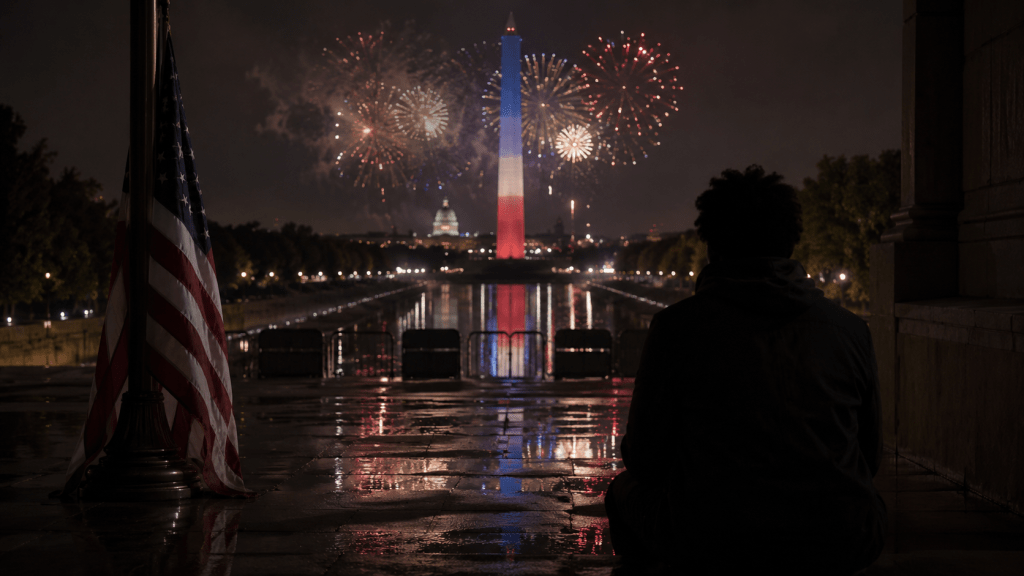
As the United States celebrates its 250th anniversary, we’re being asked to participate in national performance.
Flags. Fireworks. Speeches about freedom. Appeals to unity.
This country is presenting itself as a symbol of liberty, sacrifice, perseverance, and hope. I understand why people want to believe. I don’t reject hope.
What I reject is mythology.
At 250, this country celebrates the word “freedom” while refusing the accountability that would make freedom real.
Even the word “America” is part of the mythology. The United States has claimed the name as if it owns the entire idea of the Americas. But the Americas stretch from Canada to Argentina, across continents, islands, cultures, languages, and histories. That ownership isn’t accidental. It’s the same pattern: take the symbol, control the meaning, and call it truth.
Celebration without truth becomes propaganda. Patriotism without accountability becomes performance. And freedom without public trust becomes nothing more than a slogan.
We’re told this nation was founded on freedom.
But freedom for whom?
The same generation that declared all men were created equal tolerated slavery. The same nation that rejected political oppression displaced Indigenous peoples already living here. The same republic that condemned arbitrary power concentrated power over those least able to resist it.
That contradiction isn’t a footnote. It’s part of the foundation.
Yet every Fourth of July, we’re encouraged to celebrate a cleaner version of the story. We talk about independence, liberty, courage, and national greatness. We speak less honestly about slavery, Indigenous dispossession, racial hierarchy, and conditional belonging.
That’s not unity. That’s curation.
The United States has always been skilled at preserving the symbol while managing the memory. Keep the flag visible. Keep the speeches uplifting. Keep the story clean enough to celebrate. Trim away the suffering. Repackage the contradictions. Invite people to feel pride, but not discomfort.
That’s the power of spectacle.
A fireworks display can make people feel united for a night. A monument lit in patriotic colors can make a nation feel morally coherent. A word like “freedom” projected onto stone can feel like proof that freedom itself is secure.
But spectacle isn’t accountability. It moves people emotionally while asking nothing of them morally.
You can choreograph unity, but you can’t choreograph trust.
And this is where freedom starts to lose meaning.
Freedom can’t just be something we say during ceremonies, project onto monuments, print on banners, or invoke whenever politicians want applause. It has to mean rights are applied equally, government power is restrained, citizenship isn’t conditional, and people can challenge authority without being treated as enemies of the state.
Otherwise, freedom becomes branding.
This country loves the flag, the uniform, the anthem, and the civil rights quote stripped of its demand for justice. What it struggles with is the human being behind the symbol.
That’s where assimilation comes in.
One thing this country does well is teach people to participate in the myth. Over time, even people whose communities were once excluded can become emotionally invested in defending the story that excluded them.
That doesn’t mean people are weak. It means belonging is powerful.
People want to be accepted. They want to feel included. They want to believe they’re part of the national story. And this country offers that belonging, but often at a price: celebrate the symbol, don’t disturb the myth, don’t make people uncomfortable, don’t question the rituals, don’t interrupt the fireworks.
The cost of speaking up is real. It can cost relationships, comfort, professional standing, and the temporary safety of blending in. That’s why the system rewards silence. It teaches people that belonging is easier when they don’t challenge the story.
But when belonging requires silence, it isn’t freedom. It’s compliance.
That silence becomes especially painful when masked white supremacist groups can march openly in Washington, D.C., during a celebration of U.S. freedom and it’s treated as background noise.
The issue isn’t whether the First Amendment protects speech. The issue is whether the public treats racial intimidation as morally urgent or just another thing happening in the background.
How does a nation celebrate liberty while racial intimidation walks through its streets? How does a country speak about unity while hatred organizes under the protection of freedoms it would deny to others? How do people celebrate freedom in that moment without asking what kind of freedom we’re really talking about?
The problem isn’t that people gather with family or watch fireworks. The problem is when celebration becomes a substitute for conscience. When people who know better stay quiet because speaking honestly would disrupt the national mood, silence becomes part of the performance.
It allows this country to pretend the problem is somewhere else, in some other era, carried by some other people.
But there are people who refuse that performance. There are writers, teachers, organizers, veterans, artists, parents, and citizens who keep telling the fuller story anyway. They remind us that honesty isn’t hatred. It’s the beginning of trust.
And public trust is the real test of freedom.
A free society isn’t sustained by fireworks, slogans, military spectacle, or forced patriotism. It’s sustained by trust that power will be restrained and rights will be defended when doing so is inconvenient.
The United States is failing that test.
We’re not united because leaders say we are. We’re not free because fireworks light up the sky. We’re not honest because we remember only the parts of history that flatter us.
At 250, the United States has better branding, staging, and speeches.
But it still prefers the flag to the fact, the slogan to the truth, and the symbol to the human being.
I’m not asking people to hate the country.
I’m asking them to stop lying about it.
That starts in ordinary places: telling the fuller story, naming the contradictions, refusing to treat intimidation as background noise, and not confusing national pride with moral honesty.
Because a nation that can’t confront its own contradictions isn’t protecting freedom.
It’s hiding behind the word.


Leave a Reply