
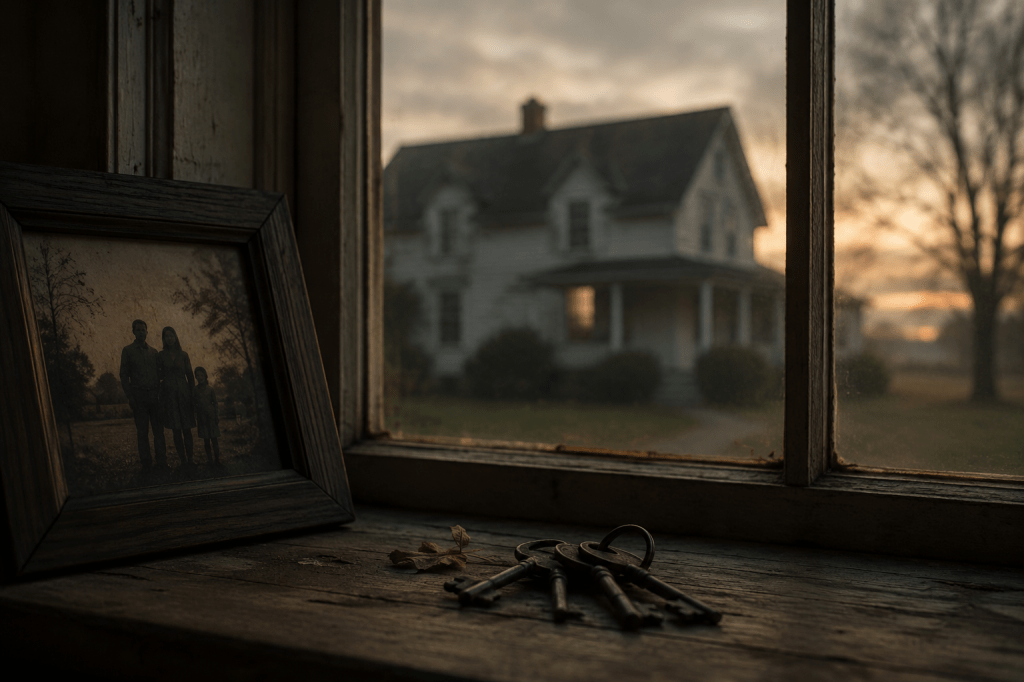
A Fictional Drama
The home where Cherie and I raised our children had been in my family for generations.
My grandparents had lived there. Their parents had lived there before them. Each generation took care of the house and passed it down to the next.
The walls were covered with family photographs. Pencil marks along the kitchen doorway showed how tall the children had grown. We had letters, birth records, military medals, recipes, and heirlooms that kept the memories of those who came before us alive.
It was the house where Cherie and I watched the children open presents on winter mornings while our pets wandered through the wrapping paper, waiting for someone to drop a piece of food.
They slept by the front window and ran to the door whenever someone came home.
The house wasn’t just property.
It was our history.
Then, one winter evening, Edward and Catherine Hale showed up at our door.
They were cold, hungry, and afraid. Their children needed somewhere safe to sleep.
We let them in.
Cherie gave them food and blankets. We offered them a room until they could get back on their feet and find somewhere else to live.
At first, they were grateful.
Then Edward’s relatives arrived.
Then Catherine’s relatives.
Then friends.
Each person asked for just a little space. Each promised it wouldn’t be permanent.
Before long, they’d taken over several rooms.
They moved our furniture. They emptied cabinets. They took down our photographs and replaced them with their own.
When I objected, Edward said, “We live here too.”
I reminded him that they were guests in my family’s home.
He said the Hales had repaired parts of the house and made improvements. Because of that, he believed they’d earned the right to stay.
Then they changed the locks.
My key no longer opened my own front door.
Neither did Cherie’s.
Our children and pets were still inside.
Edward finally opened the door, but only after telling me there were going to be new rules.
Rules about which rooms we could enter.
Rules about what we could keep.
Rules about how we were expected to behave in our own home.
Then he handed me a document claiming that the Hales now owned the property.
My signature was at the bottom.
I’d never signed it.
I went to court with the deed my family had kept for generations and records showing that we’d lived in the house long before the Hales arrived.
The judge was connected to the Hales. So was the clerk who handled the property records.
“This deed has been in my family for generations,” I told the judge.
He barely looked at it.
“Not according to our records,” he replied.
Our deed was declared invalid.
The fraudulent document was accepted as law.
The paperwork made the Hales the legal owners.
It didn’t make them the rightful ones.
The Hales took the largest rooms.
Cherie and I were moved into a smaller one. Our children were crowded together downstairs.
Our pets were put outside because Catherine said they no longer belonged in the house.
The Hales removed more of our photographs. They threw away the children’s drawings and emptied boxes filled with family letters and belongings.
Cherie found one of our oldest family photographs broken in the trash.
Catherine told her it was only a picture.
Then the Hales claimed the backyard.
They fenced off the tree my grandmother had planted and started selling its fruit.
When I reminded Edward that the tree belonged to my family, he brushed me off.
“That was a long time ago,” he said.
The Hales began telling the neighbors they’d found the house nearly abandoned.
They said they’d repaired it, organized it, and made it useful again.
They described themselves as the people who had saved it.
When we resisted, they called us hostile.
When we became angry, they called us dangerous.
When we tried to take back our belongings, the police accused us of interfering with the lawful owners.
The Hales controlled the records.
The court accepted their claim.
The police enforced it.
What started as a lie became legal ownership because the people benefiting from the lie controlled the institutions that decided what was legal.
Eventually, the Hales forced us out.
They allowed us to live in a small structure at the far end of the property. They signed an agreement promising that the remaining space would always belong to our family.
Years later, they discovered that the ground beneath it was valuable.
They broke the agreement and forced us out again.
Time passed.
Edward and Catherine Hale died.
Their children inherited the house. Then their grandchildren inherited it.
Those later generations hadn’t changed the locks.
They hadn’t forged the ownership papers.
They hadn’t broken our photographs or forced our pets outside.
They’d simply been born in the house.
To them, it had always belonged to the Hales.
They renovated it.
They raised families there.
They built businesses and successful lives.
They spoke proudly about everything their family had accomplished.
And they had accomplished a lot.
They’d worked hard. They’d improved the property. They’d built lives they had every right to be proud of—but none of that changed how their family got the house.
One of Edward’s descendants eventually wrote a history of the property.
He described how Edward and Catherine Hale had discovered a neglected, nearly empty house and turned it into a thriving home.
There was no mention of Luis or Cherie.
No mention of our children.
No mention of the family pets waiting outside the door.
No mention of the changed locks, the fraudulent papers, the broken agreement, or the family that had been forced out.
The book said the Hales had built the home from nothing.
Years later, one of our grandchildren returned to the house.
Our grandchild didn’t demand that every Hale descendant be thrown into the street.
They didn’t accuse the people living there of personally stealing the house.
They asked for the truth.
They asked for the return of the photographs and belongings that remained.
They asked the Hales to honor the agreement their ancestors had signed.
They asked them to admit that the house hadn’t been empty when Edward and Catherine arrived.
The current owner became angry.
“My family worked hard for this home,” he said.
“I know,” our grandchild replied.
“My parents were born here.”
“I know.”
“I never stole anything from your family.”
“No,” our grandchild said. “But you still have what was stolen.”
The owner said too much time had passed.
He said admitting what happened would create resentment and punish people who hadn’t done anything wrong.
Our grandchild wasn’t asking him to inherit his ancestors’ guilt.
They were asking him to accept the responsibility that came with inheriting the house.
The Hale family still had the property. They still controlled the records and benefited from promises their ancestors had broken.
Their idea of moving forward allowed them to keep everything, while our family was expected to forget.
Most people would know what had happened.
Changing the locks didn’t make the Hales the rightful owners. Controlling the records, courts, and police didn’t turn wrongdoing into justice. Renovating the house didn’t erase how they’d gotten it.
Now imagine that the house isn’t a house.
Imagine that it’s a continent.
Imagine that my family isn’t one family, but the Indigenous nations that lived here long before Europeans arrived.
The guest room becomes a settlement.
The settlement becomes a colony.
The ownership paper becomes a land grant issued by people who had no moral right to give away the land.
The court becomes the legal system of the conquering government.
The small structure at the edge of the property becomes a reservation.
The written promise becomes a treaty that’s broken once the land or its resources become valuable.
The children taught to reject their family’s history become Indigenous children taken from their homes and punished for speaking their languages or practicing their cultures.
The family belongings become sacred objects taken from their communities and placed in private collections and museums.
The rewritten history of the house becomes the story of an empty wilderness waiting to be discovered.
The difference is scale.
Scale doesn’t change what something is.
No one alive today is personally guilty just because they were born in the country that came from it.
That isn’t the point.
The descendants of the Hales didn’t inherit Edward and Catherine’s personal guilt.
They inherited the house.
And with that inheritance came a responsibility to tell the truth about how it was taken, honor the agreements that still remain, and repair what can still be repaired.
Responsibility doesn’t require inherited shame.
It requires honesty.
What’s legal and what’s right aren’t always the same thing.
Forgetting how a home was taken doesn’t make it yours.


Leave a Reply