
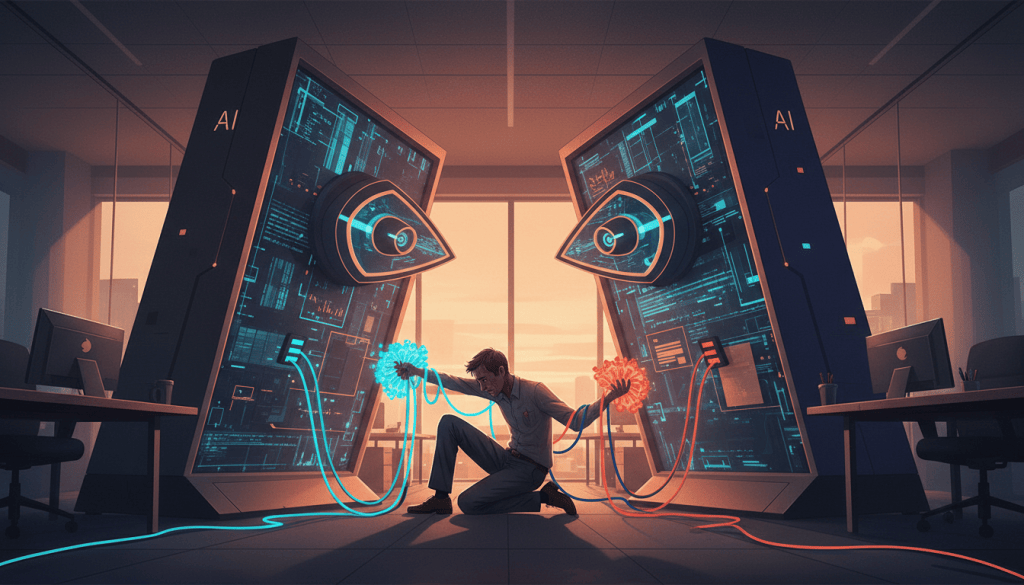
We invented technology to help humans communicate. So how the hell did I end up being the communication system between two artificial intelligences?
I became a telephone today.
I’m serious. Well, sort of.
I spent part of my Sunday afternoon serving as the communication link between two artificial intelligence chatbots.
And the really ridiculous part?
Both belonged to the same company.
Let me explain.
It started with a simple problem. I couldn’t log into ChatGPT. Something was going wrong with authentication, and I wanted to figure out why.
Now, I work in cybersecurity. I’m accustomed to troubleshooting technical problems. But that doesn’t mean I enjoy spending my Sunday diagnosing something that should just work.
So I did what millions of people do these days.
I asked ChatGPT for help.
We went through the troubleshooting process, figured out what was happening, and eventually narrowed the problem down enough to contact OpenAI Support.
Fine. Problem identified. Time to let the company responsible for the service figure out how to fix it.
Or so I thought.
Two Chatbots Walk Into a Conversation
I opened OpenAI’s support website.
And who greeted me?
Another chatbot.
Of course it was.
So now I had ChatGPT open on one side of my screen and OpenAI’s support chatbot on the other.
The first chatbot already knew everything we’d done. It had the troubleshooting history, the results of our tests, the error messages, and the information we’d gathered.
The second chatbot needed that information to process my support request.
Simple enough, right?
Except the two systems couldn’t talk to each other.
So I asked ChatGPT to summarize the problem. It prepared the explanation, and I copied it into the support chatbot.
The support chatbot responded with additional questions.
I copied those questions back into ChatGPT.
ChatGPT explained what the support chatbot wanted and helped me prepare another response.
I copied that response back into the support chatbot.
Another question.
Back to ChatGPT.
Another answer.
Back to support.
And on and on it went.
At some point, I stopped and looked at what I was doing.
There I was, sitting in front of two artificial intelligence systems, carrying messages back and forth between them like some kind of electronic errand boy.
And suddenly it hit me.
Holy shit.
I’ve become the freakin’ telephone. 😎
I actually started laughing.
Because think about how absurd that is.
Wait a Minute. Who’s the Technology Here?
For generations, humans have invented technologies to communicate with one another.
Two people wanted to talk, so we developed the telephone.
Later came email, text messaging, video conferencing, and countless other ways to exchange information.
The arrangement was straightforward.
Human → Technology → Human.
Technology was the intermediary. The tool that allowed two people to communicate.
Now look at what happened to me.
Artificial Intelligence → Human → Artificial Intelligence.
The arrangement had completely reversed.
I was no longer using technology to communicate with another human being.
Two machines were effectively communicating through me.
I was the one copying their questions, transferring their responses, and making sure each system received the information it needed.
I had become the intermediary.
The medium.
The communication infrastructure.
And here’s the part that makes it even more ridiculous.
I was the paying customer!
I wasn’t employed by OpenAI to integrate its systems. I wasn’t hired to coordinate its support operations. I wasn’t responsible for ensuring that one chatbot could get information from another.
I just wanted to log into my account.
Yet somehow, I ended up doing the administrative work necessary for two artificial intelligence systems to exchange information.
What the hell happened here?
When Did We Start Working for the Machines?
We’ve spent years talking about artificial intelligence replacing human beings.
Will AI take our jobs? Will it eliminate entire professions? Will machines eventually do everything people currently do?
But sitting between those two chatbots made me think about something I hadn’t really considered before.
What happens when artificial intelligence doesn’t replace us, but instead turns us into the support staff required to keep artificial intelligence functioning?
Think about that for a moment.
We’re told these technologies are supposed to make our lives easier.
They’re supposed to eliminate repetitive tasks, improve productivity, reduce administrative burdens, and give us more time to focus on things that actually matter.
And I believe they can.
I use AI extensively. I’m not somebody standing on the sidelines complaining that technology is ruining the world.
Quite the opposite.
I recognize what artificial intelligence can accomplish, which is precisely why this experience struck me as so ridiculous.
Here I was, using one of the most sophisticated technologies humanity has developed, and somehow I had been reduced to copying and pasting messages between two machines.
Does anyone else see the irony?
We have artificial intelligence capable of writing computer programs, analyzing complex information, interpreting images, and carrying on remarkably sophisticated conversations.
But apparently, when two chatbots belonging to the same company need to exchange information, they still require a human being to carry the messages.
And that human being was me.
I wasn’t even participating in the conversation in any meaningful sense anymore.
I was transporting it.
The Part That Isn’t So Funny
Once I stopped laughing, I started thinking about what this experience represented.
Because the more I considered it, the less it seemed like an isolated inconvenience.
How often do we already find ourselves accommodating technology rather than having technology accommodate us?
We navigate automated customer service systems that don’t understand what we’re asking.
We repeatedly provide information companies already possess.
We learn how to phrase our questions so software will recognize what we mean.
And when automated systems fail, we’re expected to spend our own time figuring out how to get them working again.
All of this gets packaged as convenience and efficiency.
But whose convenience?
Whose efficiency?
If a company automates its customer service operations and saves money, that’s certainly an improvement for the company.
But if the customer now spends considerably more time navigating automated systems, repeating information, and resolving problems that previously required a simple conversation, has anything actually become more efficient?
Or have we simply transferred the work from the company to the customer?
That’s what bothers me.
We’re increasingly measuring technological progress by what machines can accomplish and how much money organizations can save.
But how often do we measure how much additional work those same systems place on the people they’re supposed to serve?
My little adventure with two chatbots was almost comical.
But imagine that arrangement becoming normal.
Imagine a future where people spend increasing amounts of their time managing automated systems, interpreting their instructions, transferring their information, and resolving their conflicts.
Not because people want to.
But because the systems have been designed in ways that require them to.
At what point does the human stop being the person technology serves and become another component necessary for the technology to function?
That’s a question worth asking.
I Didn’t Sign Up to Be Middleware
Now, I understand that systems don’t necessarily share information automatically.
I work in cybersecurity. I understand the importance of privacy, access controls, and protecting information from unauthorized disclosure.
But there’s a difference between preventing unauthorized information sharing and making the customer personally responsible for carrying messages between two systems.
I was sitting right there.
I owned the conversation.
I was the person requesting support.
I could have authorized the relevant information to be shared.
Instead, I had to become the mechanism for sharing it.
That’s what struck me as so absurd.
We talk endlessly about how intelligent artificial intelligence has become. Yet sometimes the systems surrounding that intelligence seem remarkably incapable of handling the simplest human needs.
And the solution?
Make the human do it.
Eventually, the support chatbot offered to escalate my issue to a human support specialist.
Think about that.
I spent hours working with one AI chatbot, then became the communication channel between that chatbot and another AI chatbot, so the second chatbot could finally arrange for a human being to investigate the problem.
You couldn’t make this shit up.
Well, I suppose an AI could.
But I actually lived it.
So Who’s Supposed to Be Serving Whom?
I recently wrote an article called Progress for Whom?, questioning whether our technological and economic achievements are actually making human lives better.
This experience brought that question home in a way I hadn’t expected.
Because the issue isn’t simply what artificial intelligence can do.
It’s what we’re gradually being expected to do for artificial intelligence.
I don’t want a future where humans become the administrative assistants, translators, messengers, and troubleshooting staff for increasingly complicated automated systems.
I want a future where those systems genuinely make our lives easier.
Where technology adapts to human needs instead of demanding that humans continually adapt to technological limitations.
Where innovation gives people more freedom, not another collection of responsibilities.
And where the customer doesn’t become an unpaid employee simply because two systems can’t communicate.
I started my Sunday trying to log into ChatGPT.
I ended up becoming the telephone between two artificial intelligences.
I can laugh about it now.
But I can’t help wondering how many other ways we’re quietly reversing the relationship between people and the technologies we’ve created.
We invented the telephone so humans could talk to one another.
We invented artificial intelligence so machines could help humans.
Somewhere along the way, I became the telephone so two machines could talk to each other.
And if that isn’t one hell of a commentary on the direction we’re heading, I don’t know what is.


Leave a Reply