
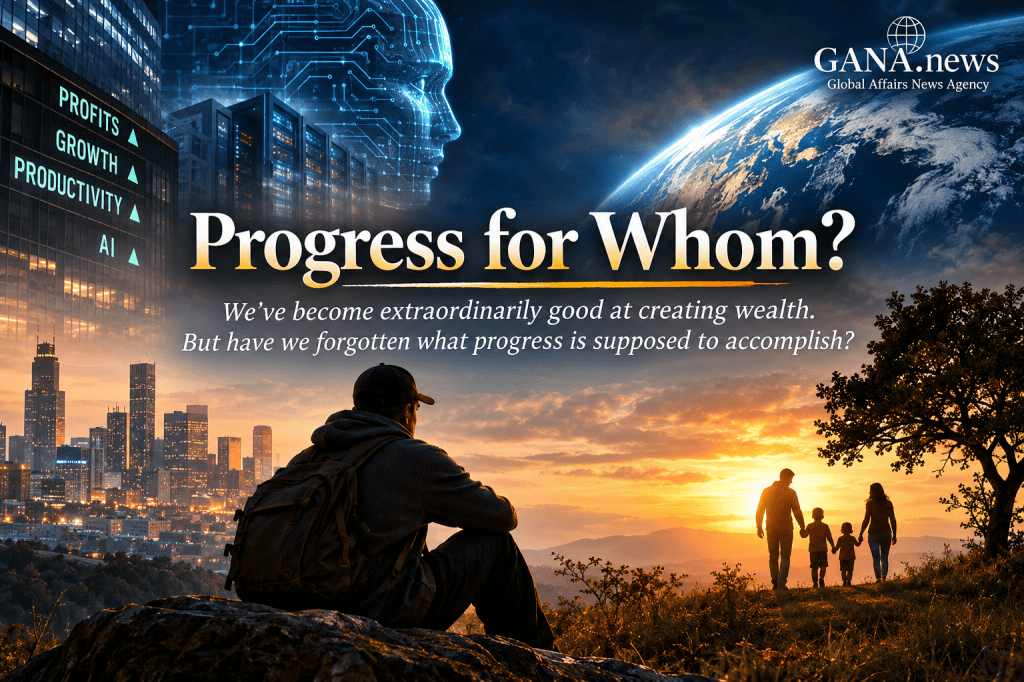
We’ve become extraordinarily good at creating wealth. But have we forgotten what progress is supposed to accomplish?
I’ve been thinking a lot about where humanity is headed, and I keep coming back to something that troubles me.
When did making money become more important than making life better?
We live in an extraordinary time. Technology has transformed virtually every aspect of our lives. We’ve accumulated unimaginable wealth, developed remarkable medical capabilities, and accomplished things previous generations could scarcely imagine.
Yet we measure nearly everything through money.
Economic growth. Corporate profits. Productivity. Shareholder returns.
We celebrate trillion-dollar companies and billionaires whose fortunes grow faster than most people could spend in a thousand lifetimes.
But what about everyone else?
Are we healthier? More secure? Do we have more time with our families? Are we less burdened by the financial demands of everyday life?
Or have we simply become better at generating wealth while expecting everyone to work harder to sustain the system that produces it?
The Promise of Productivity
Consider the 40-hour workweek.
It became the American standard nearly a century ago. Since then, technology has fundamentally changed how we work. Tasks that once required hours can now be accomplished in minutes.
Yet we’re still expected to work 40 hours.
I work four ten-hour days. Having a three-day weekend is nice, but ten-hour days leave little time for life outside work.
We’ve learned how to make employees more productive. We’ve even figured out how to compress their schedules.
But why aren’t we discussing how that productivity could give people more of their lives back?
Greater productivity creates choices. Companies can increase profits, raise wages, lower prices, reduce working hours, or distribute the benefits in some combination.
Technology doesn’t dictate those outcomes. Economic priorities and human decisions determine them.
Yet we rarely seem to question why producing more is treated as the obvious objective while working less remains an exception.
Shouldn’t technological advancement mean that we eventually need to spend less of our lives working?
Artificial Intelligence and the Same Old Priorities
Now consider artificial intelligence.
We are developing technology with extraordinary potential to improve human life. AI could accelerate medical research, improve healthcare, eliminate dangerous work, and free people from countless repetitive tasks.
That should be exciting.
Instead, listen to much of the conversation surrounding it.
Jobs will disappear. Professions will become obsolete. Entire industries will need fewer workers.
Adapt or get left behind.
And these predictions frequently come from some of the wealthiest and most influential people in technology, many of whom stand to benefit enormously from the transformation.
I find that deeply disturbing.
Why the hell are we developing technology capable of doing our work, only to present that achievement as a threat to our livelihoods?
Shouldn’t machines doing more human labor create opportunities for people to work less?
Shouldn’t we be discussing shorter workweeks, affordable healthcare, greater economic security, and more time to enjoy our lives?
Instead, we’re being told to prepare for a future in which fewer people may be needed to produce the same economic output.
And we’re expected to accept that as progress.
That’s bullshit.
In my earlier article, Who Decided?, I questioned the assumption that technological advancement automatically determines humanity’s future.
AI doesn’t decide to eliminate someone’s job.
People do.
People decide how technology is deployed, who benefits financially, and who bears the consequences.
Replacing workers is a business decision, not an unavoidable command issued by technology.
I’m not opposed to artificial intelligence. Far from it. I recognize its potential, and I believe it can accomplish extraordinary things.
What I question is our obsession with the financial opportunities it creates while treating its human consequences as something society must simply endure.
Technology isn’t the problem. The priorities governing its use deserve scrutiny.
What Are We Actually Building?
And those priorities extend beyond employment.
We’re investing enormous resources in AI infrastructure. Data centers require electricity, water, and land. Governments offer financial incentives, and communities accommodate the growing demand.
Some of these investments will produce genuine benefits.
But shouldn’t we be asking what society receives in exchange?
Not simply how much investors might earn or how much companies might save.
What are we actually trying to accomplish?
Are we building technology to improve civilization, or are we building an increasingly expensive system whose primary objective is generating even more wealth?
That question became particularly meaningful to me after reading the reflections of NASA astronaut Ron Garan.
Garan described how seeing Earth from space changed his perspective. From orbit, he saw a fragile planet sustaining billions of lives, protected by a remarkably thin atmosphere.
His observation challenged the way we’ve organized our priorities.
We behave as though the economy comes first, society second, and the planet last.
But reality works in reverse.
The planet sustains society. Society sustains the economy.
Without a functioning planet, there is no society. Without society, there is no economy.
It’s such a simple observation, yet we’ve organized much of civilization as though economic growth were the ultimate purpose rather than a means to something greater.
We exhaust natural resources, compete relentlessly for economic advantage, and celebrate extraordinary concentrations of wealth while millions struggle to meet basic needs.
And now we’re developing technology capable of dramatically reducing the amount of human labor required to produce goods and services, yet we’re discussing that achievement primarily as a threat to people’s financial survival.
Something is fundamentally wrong with that picture.
The Economy Is a Tool, Not the Purpose
Money is a human invention. So are corporations, financial markets, and the economic systems we’ve created.
They’re tools.
Important tools, certainly.
But tools nonetheless.
We created the economy to serve humanity. We didn’t create humanity to serve the economy.
I’m not arguing against capitalism, entrepreneurship, innovation, or economic growth.
I’m questioning why we’ve let those things become ends in themselves.
What good is a more productive economy if people have less time to enjoy their lives?
What good is extraordinary wealth if families remain financially insecure?
What good is technological advancement if its benefits are concentrated among those who already possess the greatest resources?
And what good is any of it if we undermine the planet that makes our existence possible?
These aren’t arguments against progress.
They’re questions about its purpose.
A Different Measure of Progress
Perhaps we’ve been measuring progress incorrectly.
Perhaps the real measure isn’t how much wealth we produce, but how much better human life becomes because of it.
Better health. Greater security. Less suffering. More freedom. More time with the people we love.
Those shouldn’t be incidental benefits we hope will eventually emerge from economic growth.
They should be the purpose of that growth.
Imagine artificial intelligence becoming a reason to celebrate the possibility of working less rather than fearing unemployment.
Imagine measuring technological breakthroughs by the suffering they eliminate rather than the profits they generate.
Imagine a society where increasing prosperity actually gives people greater freedom to live.
That seems like a future worth pursuing.
But we won’t arrive there simply by developing more powerful technology.
We have to decide what we want that technology to accomplish.
Ron Garan traveled hundreds of miles above Earth to gain a different perspective.
We shouldn’t have to travel that far to recognize what matters.
Our time. Our health. Our families. Our communities. Our shared humanity. The planet sustaining us.
These are the things that give economic progress meaning.
And if our technological achievements and accumulated wealth aren’t ultimately improving those things, perhaps we need to reconsider what we’re celebrating.
We’ve become extraordinarily good at creating wealth. But have we become any better at creating a world worth living in?
Because progress should never be about making the system more valuable.
It should be about making human life better.


Leave a Reply