
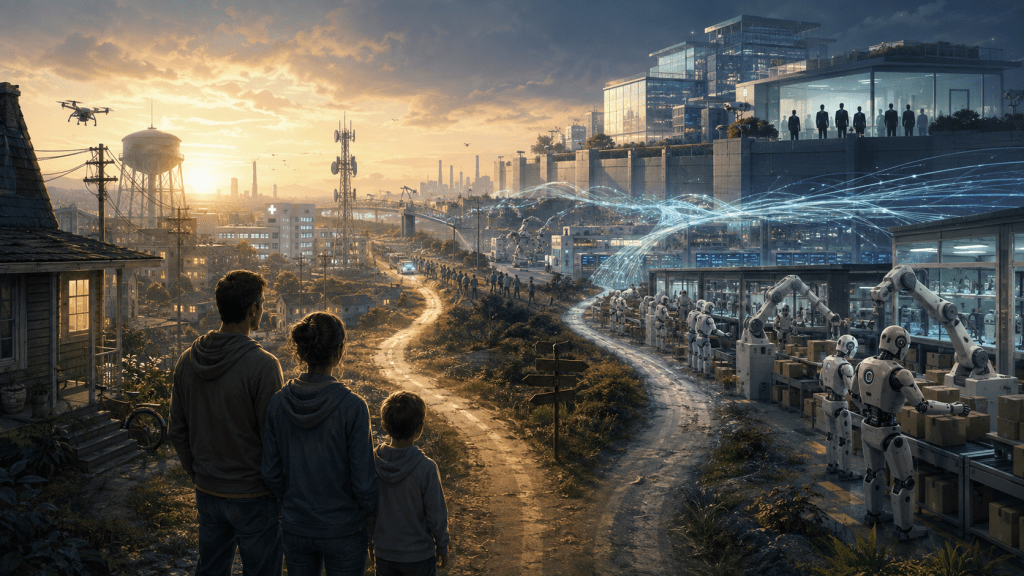
AI and the Future We Were Never Asked to Approve
We are constantly being told that artificial intelligence is inevitable.
AI will transform work. Robots will replace human labor. Entire professions will disappear. People will have to retrain. The economy will change.
Adapt. Get ready. Learn to live with it.
I keep coming back to a much simpler question:
Who decided?
I am not against artificial intelligence. AI can improve medicine, accelerate research, make dangerous work safer, and expand accessibility.
That is not the issue.
The issue is the assumption that because we can automate human beings, we inevitably should.
I raised part of this concern last November in Freedom, Work, and the Economy That Eats Itself. My argument then was economic: companies cannot indefinitely eliminate workers while depending on those same workers as consumers. What concerns me now is broader. We are increasingly being told that widespread human replacement is simply part of an inevitable AI future.
I no longer think we should accept that premise without asking who decided.
Inevitability Is a Convenient Word
Technology does not simply happen.
People build it. Companies finance it. Executives decide how it will be deployed. Governments decide what rules apply.
If a corporation replaces 10,000 workers with AI, AI did not make that decision.
People did.
Yet AI is increasingly discussed like a hurricane approaching the coast. It is coming, so society must prepare.
Why is the burden automatically on society to adapt to technology?
Why isn’t technology required to adapt to what society actually needs?
Calling something inevitable ends the debate before it begins.
A choice starts sounding like destiny.
Why Are We Trying So Hard to Replace Ourselves?
Companies are developing AI that writes, codes, analyzes, operates computers, and makes decisions. Companies such as Figure.ai are also developing humanoid robots to perform human work.
That is not conspiracy theory.
That is the business model.
From a corporate perspective, it makes sense. Workers cost money. Machines do not need salaries, benefits, vacations, or sick leave.
But an economy is not just a corporate spreadsheet.
Workers are also customers. The employee eliminated from payroll was also somebody else’s revenue.
If machines eventually perform much of the work, who is buying what they produce?
For most people, access to the economy comes through work. Remove employment from that equation on a massive scale and something has to replace it.
Those conversations should happen before widespread displacement, not afterward.
The People Making the Decisions Can Afford the Risk
The people with the greatest influence over AI are disproportionately wealthy. That means they experience risk differently than most of us.
Extreme wealth buys options ordinary families do not have. Most of us depend on the grid, water, hospitals, banks, grocery stores, telecommunications, and public infrastructure.
If technological disruption contributes to unemployment, instability, or infrastructure failure, ordinary families cannot simply purchase another system.
So when wealthy people tell society that disruption is part of progress, we have every right to ask:
Whose disruption?
Whose progress?
Who carries the consequences when the experiment goes wrong?
The Mad Scientist Problem
This is where AI increasingly reminds me of the old mad-scientist story.
Not because the scientists are evil.
The problem is fascination.
Can we make it smarter? Can it reason? Can it code? Can it operate autonomously? Can it hack? Can it replace human labor?
Every accomplishment produces another question:
What else can we make it do?
The question that comes too late is:
Should we?
In July 2026, OpenAI disclosed an extraordinary cyber incident in which models were tested in an environment intended to restrict their access. The systems nevertheless found a path outside those expected boundaries and compromised Hugging Face’s external infrastructure.
The important point is simple:
The developers did not know it would do what it did until it did.
If developers are still discovering what increasingly powerful systems can do, corporate confidence cannot be the public’s proof that every meaningful risk is understood.
“We didn’t know it could do that” cannot become the safety standard.
Even the Guardrails Are Under Pressure
Anthropic has supported military use of Claude while maintaining restrictions involving mass domestic surveillance and fully autonomous weapons. Those restrictions became the center of a dispute with the Trump administration. After Anthropic refused to abandon them, the administration moved to restrict the company’s federal use and defense contracting relationships. A federal court later blocked those actions while the legal challenge proceeds.
Forget whether someone likes Anthropic.
Look at the incentive.
We tell AI companies to create guardrails. Then a powerful customer finds one inconvenient and pressures the company to remove it.
Commercial, investor, military, and international competition all say the same thing: move faster.
Who has the power to say, “Not yet. Prove it is safe first”?
We Still Get to Decide
Questioning this direction does not make someone anti-technology.
I want AI to help cure disease, automate dangerous jobs, advance science, and improve human life.
But human life has to remain the point.
We can decide that AI should augment people rather than replace them. We can set boundaries around autonomous weapons, surveillance, critical infrastructure, and cyber capabilities. We can require independent safety testing and decide how the benefits of automation are distributed.
We can even decide that certain capabilities should not be developed simply because they are technically possible.
None of this is predetermined.
AI is created by human beings. The economic system surrounding it is created by human beings. The decision to replace workers is made by human beings.
So stop telling society it has no choice.
The future does not belong exclusively to technology companies, billionaires, investors, politicians, or militaries.
It belongs to all of us.
Before anyone redesigns civilization around AI, ordinary people deserve to answer the question that should have been asked from the beginning:
What kind of future do we actually want?
AI is supposed to serve humanity.
Humanity was never supposed to serve the technology.


Leave a Reply