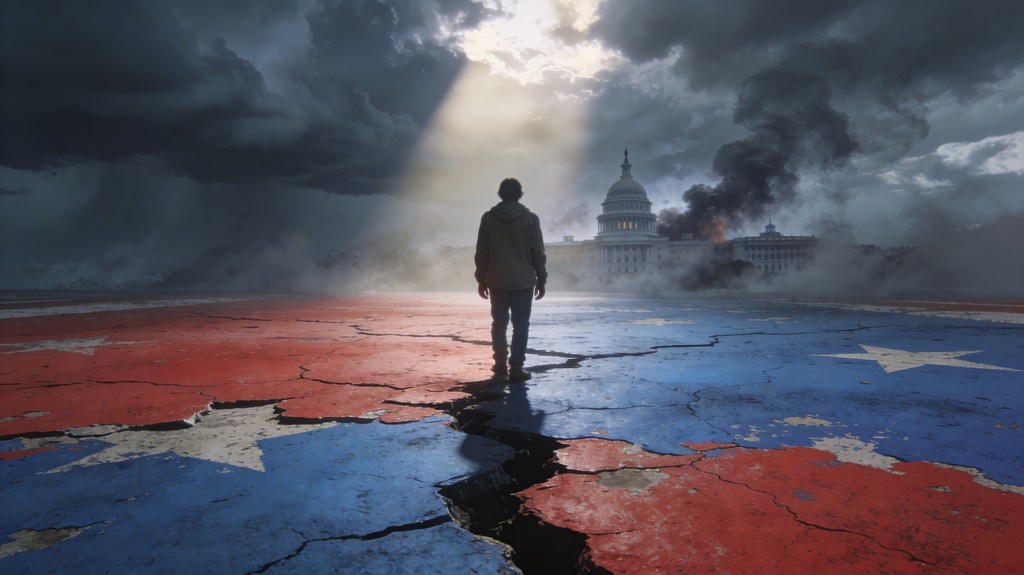
From Warning Signs to Alarm Bells
When I first wrote about being politically homeless in April 2025, I described a system addicted to outrage, false binaries, and performative loyalty tests. I argued that neither party was serious about governing for all Americans and that millions of us were left unrepresented.
I thought I was issuing a warning. One year later, it feels more like I was writing an introduction to the madness that followed.
What I said then
A year ago, I wrote:
- That the two party system thrived on manufactured division, tribal identity, and culture wars instead of problem solving.
- That I was politically homeless, not apathetic, but exhausted by parties that demanded loyalty while refusing to govern for the whole country.
- That most Americans I knew were not extremists; they wanted wages that matched the cost of living, accessible healthcare, real security without fearmongering, and civil liberties that applied to everyone.
- That I believed in structural reforms, ranked choice voting, open primaries, nonpartisan redistricting, and campaign finance transparency as ways to change the incentives, not just the faces.
Even then, that felt like a sober, maybe slightly pessimistic analysis of a sick system. I believed we were on a dangerous path. I did not realize how fast we would sprint down it.
What happened in the year since
In the twelve months after that article, the trends I worried about did not just continue, they spiked.
Political homelessness became measurable. By early 2026, national polling showed a record-high 45 percent of Americans identifying as political independents, with just 27 percent each calling themselves Democrats or Republicans. The quiet feeling I described, “I do not belong in either party anymore,” is now the most common answer in the country.
Polarization hardened. Indices that track unity and polarization show the United States continuing its trend toward increased polarization and declining trust, with more Americans concentrated at ideological extremes and fewer in the middle willing to claim either party as a home.
Outrage crossed into menace. Threats against members of Congress and their staff spiked nearly 58 percent in 2025, to almost 14,938 incidents, the highest on record and the third straight year of increases. Surveys now show large majorities of Americans saying political rhetoric has “gone too far” and that politically motivated violence is increasing.
The environment I called “performative and divisive” last year has curdled into something openly dangerous.
From tribalism to state intimidation
Last year, I wrote about partisanship and culture wars. This year, I have to add something darker: the way state power is being aimed at the public itself.
In early 2025, DHS issued guidance allowing ICE officers to enter homes to arrest people based only on ICE’s own administrative warrants, without a judge’s warrant. Legal experts and members of Congress across parties flagged this as a direct threat to Fourth Amendment protections.
Reporting and advocacy groups have documented warrantless home entries, mass raids, and people with no criminal records, including United States citizens, being swept up in aggressive enforcement campaigns.
ICE has been pushed toward daily arrest quotas in the thousands, which incentivizes fear inducing, highly visible operations that terrorize entire communities rather than focus narrowly on genuine security threats.
Senior officials have explicitly threatened to deploy ICE into airport security lines in the middle of funding and immigration fights, a naked use of armed federal agents as a political cudgel, not a response to a specific security need.
Last year, I worried about a government that performed outrage. This year, I am watching a government that increasingly performs domination in homes, airports, workplaces, and public squares.
From “no more wars” to another forever war
In my original article, I criticized both parties for using foreign policy and national security as props in their domestic culture wars. I said we needed security without fearmongering and strategy without perpetual conflict.
One year later, the same president who ran on “no more stupid wars” has dragged the United States into a new, open ended war with Iran.
On 28 February 2026, the United States and Israel launched surprise airstrikes across Iran, killing Iran’s supreme leader and triggering what is now widely known as the 2026 Iran war.
For weeks, the United States and Israel have been “hammering Iran” with strikes. At the same time, Iran and its allies retaliate across the region in ways that threaten global shipping, energy markets, and United States forces.
Serious analysts across the political spectrum agree on a brutal truth: this war lacks clearly defined objectives, a coherent strategy, congressional authorization, and a credible exit plan.
The man who branded Democrats as war mongers has now committed the country to exactly what he once campaigned against: a discretionary war with shifting rationales, no end state, and enormous risks for ordinary Americans who never voted for this.
It is the foreign policy version of the same impulse I see at home, where power is asserted first and justification improvised afterward.
What this does to political homelessness
When I first wrote about being politically homeless, it was mostly about identity. I could not square my values, justice, security, civil liberties, and competence with any party’s platform or behavior.
After this past year, my homelessness feels less like a sad joke and more like a moral necessity.
- I cannot “come home” to a political system that tolerates fascist, racist, or eliminationist rhetoric as normal politics.
- I cannot “come home” to institutions that shrug at warrantless home entries and openly use enforcement agencies as scare tactics.
- I cannot “come home” to leaders who promised to end endless wars and instead walked us into a conflict with Iran with no clear off ramp.
Political homelessness is no longer just about not fitting in. It is about refusing to legitimize behavior that is actively dangerous to democracy, to human rights, and to basic constitutional order.
What responsible refusal looks like now
If the last year has taught me anything, it is that you cannot just call yourself politically homeless and disappear. The stakes are too high. So here is what my refusal looks like today:
- I still vote, but as triage, not identity. I look for candidates who are least likely to escalate violence, trample rights, or treat war and raids as props. If no one meets a minimum standard, I am willing to withhold my vote in that race rather than endorse madness.
- I invest more energy locally and issue by issue, where results are visible, and ideology is less of a performance.
- I double down on supporting reforms that weaken the grip of extremists and war mongers, ranked choice voting, open primaries, nonpartisan redistricting, and real transparency around money and lobbying.
- I refuse to soften my language. When the government behaves like an intimidation machine, when rhetoric edges into fascism, when we stumble into war without strategy or exit, I will call it what it is.
The juxtaposition
Last year, I wrote as someone stepping away from a burning house. This year, I am writing as someone watching the fire spread to our institutions, our borders, our foreign policy, and our daily sense of safety.
The facts justify the shift:
- More independents than ever.
- More threats, more political violence, more openly violent rhetoric.
- More aggressive, constitution stretching uses of state power.
- A new, ill defined war sold by the same people who promised no more wars.
If you feel more unsafe, more skeptical, and less willing to play along than you did a year ago, you are not overreacting. You are seeing clearly.
I remain politically homeless. But I refuse to be silent about what has happened in the year since I first said it out loud.
 GANA
GANA 
Leave a comment