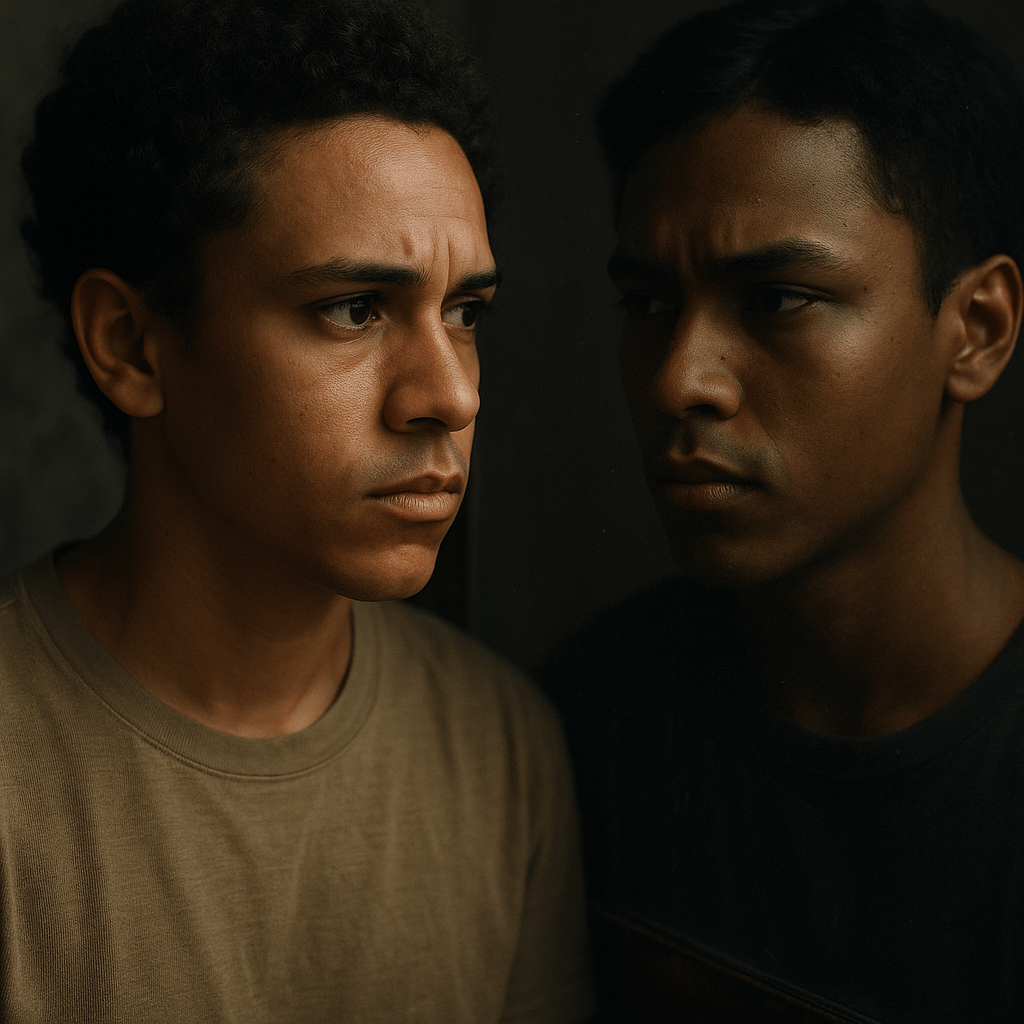
We often think of racism as something that happens between groups, white against Black, powerful against powerless. But the truth is, it also lives within communities, passed down through the same systems that taught us to survive by dividing ourselves.
Author’s Context
I write this as a Puerto Rican, part of a people shaped by colonization, resilience, and survival. We blend our music with our African roots, carry Indigenous ancestry in our blood, and speak two languages that were never ours to begin with. Neither Spanish nor English is our native language, yet both define how we move through the world. I use the Puerto Rican experience as my frame, but this reflection belongs to anyone whose community has been taught to turn inward instead of uniting outward.
The Essay
In this country, racism is almost always described as white against everyone else. But racism doesn’t only flow in one direction. It seeps sideways and inward. It turns people of color into reflections of the same hierarchy that oppressed them, competing for proximity to power, dividing themselves by shade, accent, education, or geography. That’s what gatekeeping looks like when belonging becomes a test, and our own people become the judges.
Among Puerto Ricans, it shows up in quiet ways. Island against diaspora. Spanish against English. Light against dark. The Spaniards gave us one language of control; the Americans gave us another. Both taught us to forget who we were before either flag touched this land.
Long before 1493, the Ortoiroid, Igneri, and Taíno peoples lived here, named this island, and built a culture thousands of years deep. We rarely talk about them, because our education taught us to start our history with conquest. That’s how internalized racism works; it doesn’t just change what you believe about others; it rewires what you believe about yourself.
You see it when someone says a Puerto Rican born in New York isn’t “real.” You see it when lighter skin is treated as a compliment. You see it when people correct each other’s accents or use gringo as an insult among their own. None of this started with us; it’s the echo of colonial hierarchy passed down like tradition.
And it isn’t only Puerto Ricans. The same patterns exist in Mexican, Black, and Asian communities, people debating who’s “authentic,” who’s “too American,” who’s “forgotten their roots.” The words change, but the damage is the same. Every colonized or marginalized group has absorbed the idea that belonging must be earned by imitating the people who once denied it to them. And when we turn that imitation into a standard, we start guarding the gates instead of opening them, deciding who’s “authentic,” who’s “lost,” who’s “too much” or “not enough.” That’s not pride. That’s conditioning doing its job.
White superiority was never just taught to white people; it was drilled into everyone. Poor whites were told they were better than the most educated Black person. People of color were told their worth depended on how closely they matched whiteness. That conditioning keeps us separated, angry at each other instead of united against the system that profits from division.
What we call a race war is really a distraction from a class war, the haves against the have-nots, hidden behind a curtain of color and culture. The people at the top feed us narratives about who’s “real,” who’s “illegal,” who’s “lazy,” and who’s “ungrateful,” because they know that as long as we’re fighting each other, we’ll never look up.
Healing starts with calling this what it is: learned behavior. Colonizer thinking. It’s not natural to hate someone who looks like you, or to doubt someone who shares your ancestry. That’s a taught reflex. Once you see that, you can choose not to repeat it.
Being Puerto Rican, Mexican, Black, Asian, whatever you are, isn’t about geography or language. It’s about connection to struggle, to memory, to people who survived being told they were less and still stood tall.
If we want to end the racism that hits us from the outside, we have to root out the one that lives inside, and stop guarding the gates that were never ours to begin with. Because the call isn’t just coming from outside the house, it’s coming from within it. That’s where the real work begins.
 GANA
GANA 
Leave a comment