(A six-month follow-up to “America Alone”)
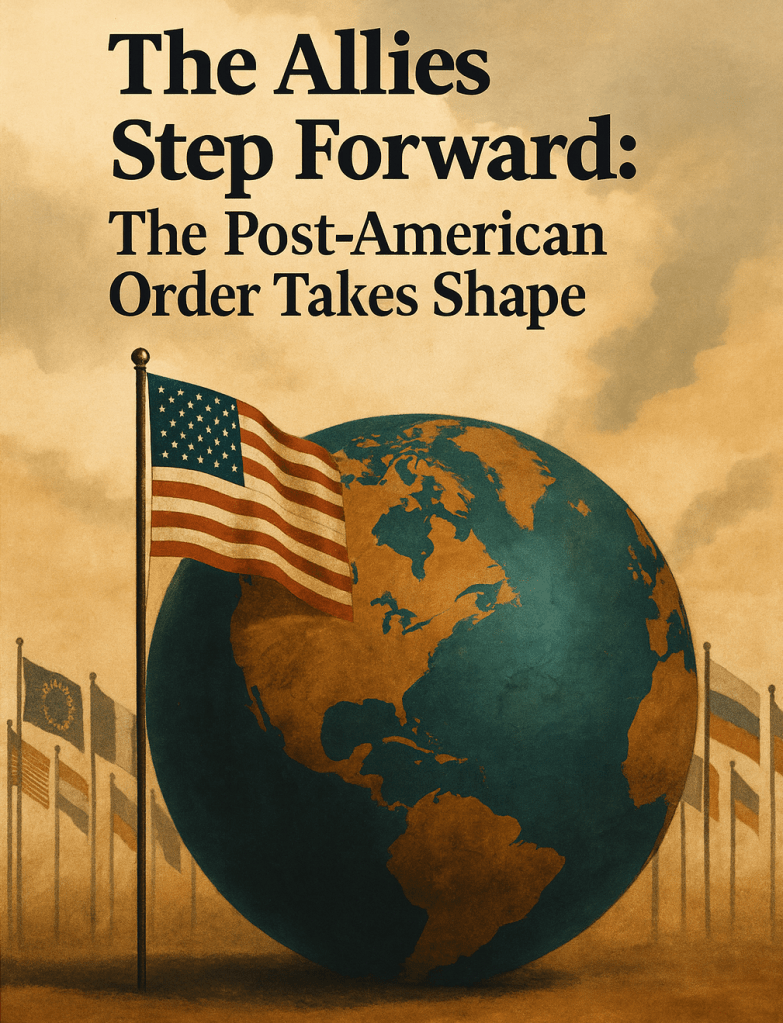
Introduction: A Prediction Realized
Six months ago, my analysis in America Alone warned that Washington’s unilateral trade and foreign policy decisions were pushing the world toward realignment. That warning has now materialized. The international system is entering a new phase where the United States remains powerful but no longer predictable, and its allies are building mechanisms to function independently of constant American direction.
At the 80th United Nations General Assembly, this transition was clear. The United States participated in every major forum, yet its partners coordinated policies with increasing independence. The world is no longer waiting for U.S. leadership. It is learning to proceed despite its inconsistency.
The U.S. Factor: Internal Dysfunction and Strategic Drift
The roots of this global rebalancing lie within the United States itself. Tariff expansion, reductions in foreign aid, and a fluctuating approach to alliances have created uncertainty about American reliability. Political polarization has made foreign policy episodic and transactional rather than strategic.
The “Liberation Day” tariff policy in April 2025 marked this shift. The administration’s decision to impose a universal ten percent tariff on imports, framed as economic self-defense, reflected a broader inward turn. Combined with reduced multilateral engagement and sporadic funding cuts to international organizations, it sent a message that U.S. commitments are now contingent on domestic politics.
For allies who depend on predictability, the result has been a pragmatic reassessment of how to sustain stability in a world where America’s position shifts with each election cycle.
Europe: Strategic Autonomy Becomes Policy
Europe is moving from discussion to implementation of strategic autonomy. Josep Borrell, the European Union’s foreign policy chief, has repeated that Europe must “build its capacity to act.” France and Germany are deepening defense industrial cooperation. The United Kingdom, Japan, and Italy are advancing the Global Combat Air Program to develop a next-generation fighter aircraft.
During the UN General Assembly’s High-Level Week, the G7 foreign ministers met under Italy’s chairmanship. The participants included Canada, France, Germany, Italy, Japan, the United Kingdom, the United States, and the European Union. Their joint statement reaffirmed support for Ukraine, multilateral reform, and a rules-based order. The tone emphasized shared responsibility rather than dependence on U.S. leadership.
Within Europe, the European Council continues to plan for a small, rapid-deployment force under EU command. NATO remains central, but its members are preparing to shoulder greater responsibility within the alliance.
The Indo-Pacific: Shared Security and Economic Coordination
In the Indo-Pacific, democratic partners are strengthening cooperation on trade, technology, and defense. Japan, South Korea, Australia, and New Zealand are strengthening their security and economic ties with one another and with Europe.
The Comprehensive and Progressive Agreement for Trans-Pacific Partnership, or CPTPP, has become the primary economic framework for this cooperation. The United Kingdom joined in late 2024, while South Korea continues to assess membership. The European Union has explored ways to improve coordination with CPTPP economies. These efforts reflect a determination to protect open trade and maritime stability amid strategic competition between the United States and China.
Economic Fragmentation: Tariffs and Retaliation
The United States’ “Liberation Day” tariff policy triggered global countermeasures. The European Commission activated its Anti-Coercion Instrument to coordinate potential retaliatory actions. Canada, Mexico, and Australia have diversified trade flows toward Europe and Asia.
Analysts at the Center for Strategic and International Studies estimated that such tariffs could raise U.S. consumer prices by about seven percent and reduce GDP by roughly 0.8 percent. Those projections align with current inflation trends and currency volatility. Globalization has not collapsed, but it has fractured into overlapping blocs that emphasize security and resilience over efficiency.
Technology and Defense: Building Redundancy, Not Rivalry
Allied nations are investing in shared defense and technology programs to strengthen resilience. The Global Combat Air Program illustrates this evolution toward interoperability and joint production. Similar cooperation is emerging in artificial intelligence, cybersecurity, and semiconductor manufacturing among G7 members and regional partners, including South Korea and Taiwan.
These initiatives are not attempts to rival U.S. capabilities. They are contingency planning measures designed to maintain stability when American policies shift. The United States remains the cornerstone of collective defense, but its partners are constructing a system that can operate effectively during periods of U.S. uncertainty.
Persistent Fractures
Allied coordination remains uneven. France and Germany continue to compete over defense industrial priorities. Japan and South Korea are rebuilding trust after decades of historical friction. The United Kingdom’s post-Brexit position complicates integration with EU defense planning. Yet these tensions no longer paralyze cooperation. The cost of fragmentation now outweighs the importance of political differences.
The Global South: Expanding Leverage
The Global South has moved from the margins to the negotiating table. Brazil, India, and South Africa have gained influence through the BRICS framework and through the African Union’s permanent membership in the G20. These nations are not aligning with any single bloc. Instead, they are using multipolar competition to secure favorable trade and investment terms.
This reflects a deeper transformation in global governance. Power is diffused, and legitimacy increasingly depends on regional leadership and economic leverage rather than on alliance alignment with a single superpower.
The Consequences: Redundancy and Global Risk
The rise of allied redundancy carries both benefits and risks. On one hand, shared capacity enhances resilience and limits the fallout from U.S. political volatility. On the other hand, a decentralized alliance system complicates the coordination of rapid crises. In conflicts such as Ukraine or Gaza, fragmented decision-making can delay response times and blur accountability.
As the world moves toward a multipolar equilibrium, deterrence itself becomes harder to maintain. No single nation can compel coherence. The next phase of this order will test whether distributed leadership can deliver stability or whether it will produce paralysis in moments of crisis.
Conclusion: From Isolation to Organization
The global order is no longer anchored by unquestioned U.S. leadership. America’s domestic volatility and protectionist turn have forced allies to adapt. They are not rebelling against Washington, but they are learning to act when Washington hesitates.
Six months ago, America Alone described a superpower isolating itself through unilateralism. Today, The Allies Step Forward documents how the world that America isolated itself from in April is now organizing itself in October.
The post-war order endured because the United States built and led it. The post-American order is emerging because the world has learned to function even when it does not.
 GANA
GANA 
Leave a comment