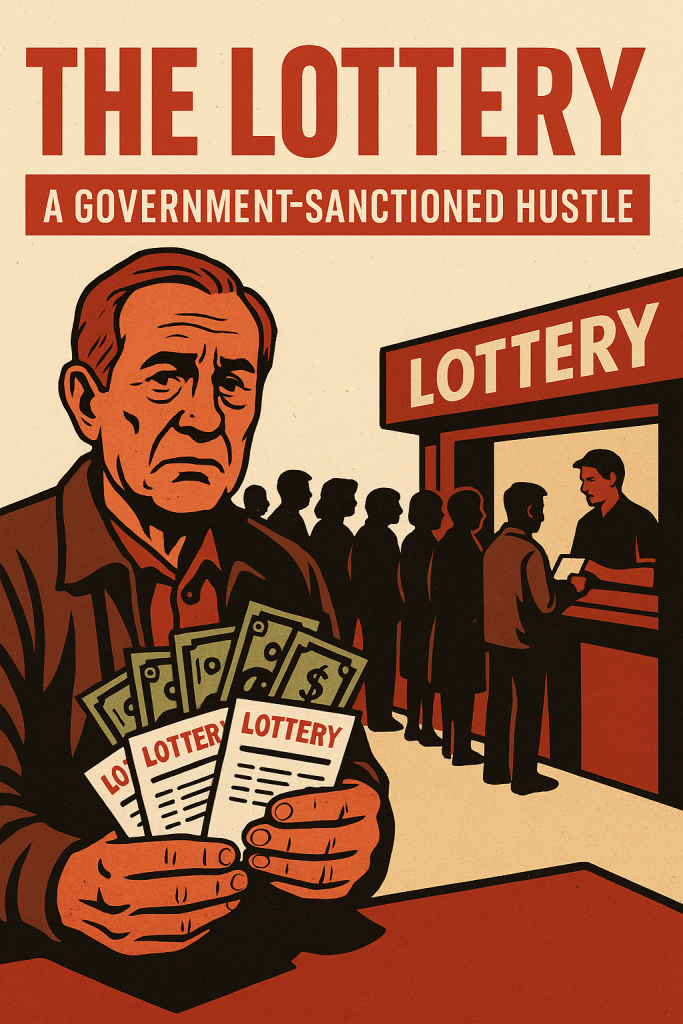
A Government-Sanctioned Hustle
People love to say the lottery is just “a little fun.” Two bucks for a dream. A chance to imagine the yacht, the mansion, the freedom from bills that never seem to end. Politicians pitch it as a way to “fund education.” Billboards tell you to play because “somebody’s gotta win.”
Here’s the truth nobody wants to say out loud: the lottery is one of the biggest hustles in America. And the dealer isn’t some shady mob boss, it’s the state itself.
I Saw It Firsthand
In my first job back in the 80s, I worked the counter at a pharmacy that had a lotto machine. During the week, ticket sales were steady. But Saturdays? Saturdays were a spectacle. The line wrapped around the block, people clutching envelopes stuffed with pre-filled lotto cards and cash. We had regulars who never missed a week. Some dropped off $500, $700, sometimes close to a thousand dollars. Every week.
And the thing is, every once in a while, they’d win. Maybe enough to cover what they spent. Perhaps a little extra to keep the dream alive. But most of the time? They walked away empty-handed, only to come back again the following Saturday with another envelope.
Looking back, I realize it wasn’t just gambling. It was a ritual. It was hope disguised as habit. For many of those folks, the lottery wasn’t entertainment; it was their financial plan.
The Trap Disguised as Fun
That’s the heart of the problem. Lotteries are marketed as harmless games, but the system is designed to hook people, especially those already struggling. The odds of hitting Powerball? One in 292 million. You’re literally more likely to be struck by lightning twice. Yet the small wins and “near misses” keep players convinced the jackpot is coming.
And it’s not casual players who keep lotteries afloat. It’s the repeat buyers, the ones pouring hundreds or thousands into tickets year after year. Studies show lottery participation is highest in low-income, minority, and working-class communities. That’s not a coincidence. States deliberately market the dream where people are most desperate. It’s not entertainment, it’s extraction.
The Big Lie: ‘It Helps the Schools’
Politicians defend lotteries with a simple pitch: the money goes to schools, parks, or other public goods. But the reality is murkier. In many cases, lottery revenue doesn’t add to those budgets; it just replaces existing funding. The net effect is minimal. Meanwhile, the poor foot the bill while the benefits are spread broadly, often helping communities that don’t spend nearly as much on tickets.
That’s not noble. That’s redistribution in reverse.
Choice or Manipulation?
Some argue, “Well, no one forces you to play. It’s voluntary.” Sure. But ethics isn’t just about choice; it’s about fairness. When the government designs a system it knows is predatory, markets it aggressively to vulnerable groups, and profits off addiction and false hope, the “voluntary” defense collapses. That’s not free choice, it’s manipulation dressed up as fun.
A Question of Dignity
Governments are supposed to protect citizens, not prey on them. But lotteries turn states into bookies. They normalize gambling, encourage addictive behavior, and reduce citizens to revenue streams. That’s not governance, it’s exploitation.
From any ethical lens, the lottery fails. Utilitarian? The harms outweigh the good. Deontological? Citizens are treated as means to an end, not as ends in themselves. Justice? The burden falls hardest on those already disadvantaged. The only defense left is libertarian freedom of choice, but when the state itself rigs the table, that defense doesn’t hold water.
The Real Jackpot
So no, the lottery isn’t a scam in the criminal sense. It’s worse. It’s a state-backed con, marketed with billboards and jingles, draining the lower income while calling it public service. If a private company ran a scheme like this, we’d call it predatory. But because it’s the government, we shrug and keep buying tickets.
And that’s the real jackpot for them, not for you.
 GANA
GANA 
Leave a comment