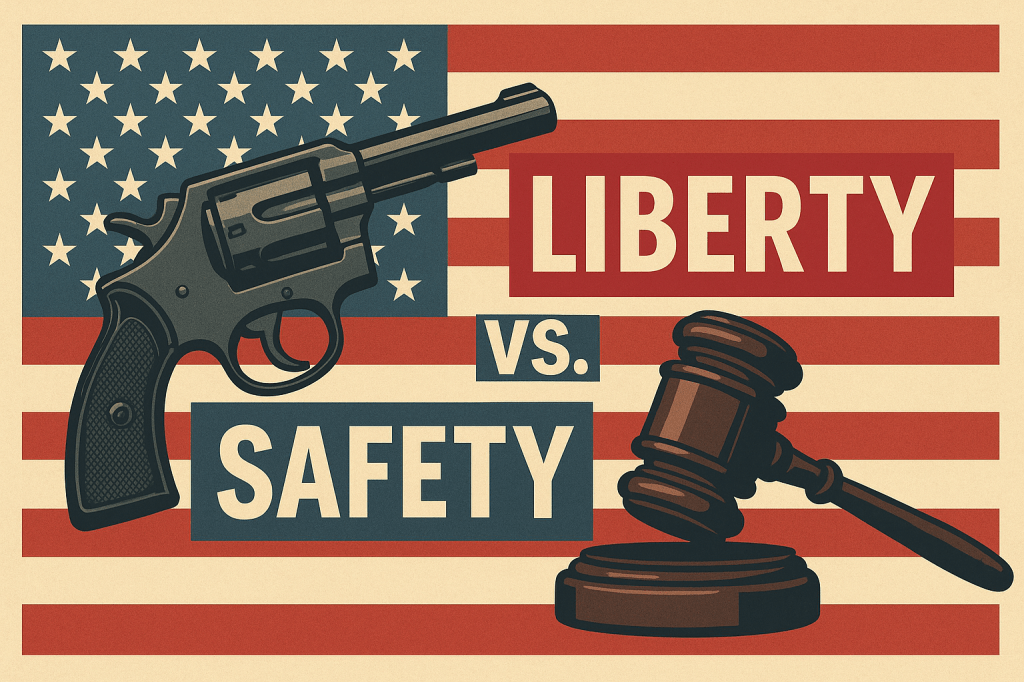
America’s constitutional culture is built on contradictions. We claim to hold our freedoms sacred, yet the way we interpret and defend those freedoms reveals a dangerous double standard. Nowhere is this clearer than in how we treat the First and Second Amendments. Both are written in sweeping, absolute language. Both say their protections “shall not be infringed.” Yet in practice, one is endlessly regulated while the other is treated like holy scripture.
This is selective fundamentalism, the tendency to apply absolutism when it suits ideology and opportunism when it does not. At its heart, it’s the tension between safety and liberty, but applied inconsistently depending on which right is under discussion.
The First Amendment: Safety over Liberty
The First Amendment declares that “Congress shall make no law … abridging the freedom of speech.” Taken literally, that language suggests speech is absolute. Yet Americans know that’s not the case. Courts and legislatures have consistently recognized limits, usually in the name of public safety or order:
- You cannot incite violence or issue actual threats.
- You cannot publish libel, slander, or classified national security information.
- You cannot distribute child pornography.
- You cannot protest wherever you wish; speech is restricted by “time, place, and manner” rules.
Even conservatives who rail against “woke censorship” have no problem restricting speech when it comes to classrooms, books in libraries, or protests outside abortion clinics. In short, free speech is honored in principle but constrained in practice, always balanced against the risks of harm. Here, safety trumps liberty.
The Second Amendment: Liberty over Safety
The Second Amendment proclaims that “the right of the people to keep and bear Arms, shall not be infringed.” If the First Amendment proves that no right is absolute, you would expect the same principle to apply here. But in American politics, it doesn’t.
For many conservatives, any restriction on guns is seen as tyranny, even the mildest regulations: universal background checks, bans on high-capacity magazines, red-flag laws for those at risk of violence. Even after children are slaughtered in classrooms and parishioners are gunned down in churches, the refrain remains the same: liberty must never yield to safety.
The Supreme Court has enshrined this absolutist stance in decisions such as Heller (2008), McDonald (2010), and Bruen (2022), which elevated the Second Amendment to near-untouchable status. In law and culture, the right to bear arms is treated as if it were carved into stone tablets, sacred, eternal, beyond compromise.
The Hypocrisy in Plain Sight
The contradiction is glaring. With the First Amendment, we accept and enforce limits whenever safety is threatened. With the Second Amendment, many insist that no limits are acceptable, regardless of the number of lives lost.
- Free speech, the foundation of democracy, is constantly qualified.
- Gun rights, the tools of violence, are treated as sacred absolutes.
That is the hypocrisy of selective fundamentalism: America negotiates away the liberty of speech while sanctifying the liberty of arms.
The Racial Origins of the Second Amendment
There is another layer of hypocrisy that cannot be ignored: when the Second Amendment was ratified in 1791, it was never meant to apply universally.
- Enslaved Africans were legally barred from owning or carrying firearms under the Slave Codes.
- Free Blacks were often prohibited from possessing arms without special licenses that were rarely granted.
- Native Americans were explicitly excluded from “the people,” treated as hostile nations to be disarmed by militias.
- Militias themselves, the “well-regulated” bodies referenced in the Second Amendment, were overwhelmingly white and often deployed to suppress slave revolts and enforce racial control.
The irony is that even this exclusionary framing has been warped. As Dominic Erdozain argues in One Nation Under Guns, the Second Amendment has been read backwards. The framers placed the justification first, “A well-regulated Militia, being necessary to the security of a free State…” and the right to bear arms followed as a subordinate clause. In other words, the right existed to serve the militia. However, over time, courts and activists have elevated the last words, “shall not be infringed,” as if they stood alone, turning a collective duty into an absolute individual entitlement.
The Supreme Court cemented this inversion in Heller (2008), which declared for the first time that the Second Amendment guarantees an individual right to own firearms for self-defense, independent of militia service. This wasn’t fidelity to the framers; it was a reversal of their intent.
So the hypocrisy runs on two levels: first, the Second Amendment never applied to non-whites at its founding; and second, it has been reinterpreted backwards to sanctify unlimited liberty where the framers themselves had tied it to regulation and civic duty.
The Car Argument: A False Comparison
Gun rights activists often say, “Well, cars kill people, too, but nobody is trying to ban cars.” It sounds clever until you remember the obvious truth: Cars are heavily regulated far more than guns.
- Licensing & Training: You can’t just buy a car and drive it without proving competence. You must pass vision tests, written exams, and a practical driving test. Gun buyers face nothing close to this nationwide.
- Registration & Insurance: Every car must be registered with the state, tagged, and inspected. Drivers are required to carry insurance to cover the harm they might cause to others. Guns? No universal federal registration, no insurance requirement, and in many states, no record at all of who owns what.
- Rules of Use: Driving is governed by thousands of safety laws, speed limits, DUI rules, seatbelt laws, traffic signals, and roadworthiness standards. Guns face no such universal usage rules.
- Design & Safety Standards: Cars must meet strict federal safety standards, with recalls issued for defects. Guns, even though designed solely to kill, face no comparable safety oversight.
Yes, cars kill people, but society has done everything possible to minimize the risk of death while still allowing their use. With guns, many resist even the mildest of comparable measures.
The car analogy doesn’t prove the point gun rights activists think it does. In fact, it proves the opposite:
- Nobody is trying to ban cars.
- Nobody is trying to ban guns.
- But society demands responsible rules, training, and accountability for car usage, and yet balks at applying the same principle to firearms.
If conservatives were consistent, they would embrace the car model: treat guns the way we treat cars, accessible, yes, but regulated for public safety. Instead, they pretend that any restriction is tyranny. That exposes once again the hypocrisy of selective fundamentalism: liberty is sacred when it comes to guns, but negotiable when it comes to everything else.
The Mental Health Deflection
Another familiar refrain after every mass shooting is: “It’s not the gun, it’s the person. This is a mental health issue.” This deflection tries to protect the weapon by shifting blame entirely onto the shooter.
Of course, mental health matters. Nobody denies that. But society already has a clear model for what happens when mental health risks intersect with dangerous tools, and guns are the glaring exception.
- Driving Restrictions: If someone is deemed medically unfit to drive because of seizures, dementia, or severe mental illness, their license can be suspended or revoked. They must demonstrate stability before being permitted to return to the road.
- Gun Ownership: In many states, someone with a serious mental health condition can still legally purchase or keep firearms unless they’ve been formally adjudicated in court. That is an extremely high bar that rarely applies in practice.
This creates a bizarre double standard: we treat cars, which are designed for transport, with more caution than guns, which are designed to kill.
If conservatives truly believed their own argument, they would support red-flag laws, mandatory reporting systems, or licensing modeled after driver’s requirements. But they don’t. They invoke mental health only as a shield against gun regulation, not as a genuine solution.
Mental illness exists everywhere in the world. Yet no other developed nation experiences mass shootings at the scale America does. The difference is access to firearms, and refusing to address that reality is not a principle; it is denial.
A Real-World Example: Safety When Convenient
The double standard isn’t just philosophical. It shows up in policy. After the massacre at a Catholic school in Minnesota in 2025, the Trump Administration announced $110 million in security funding for faith-based organizations. The money, administered through FEMA’s nonprofit security grant program, will cover the costs of cameras, gates, training, and other hardening measures.
This is a safety-first initiative, and rightly so. Yet not a single conservative voice called this an infringement on liberty. Nobody shouted that this was government overreach or tyranny. Instead, it was hailed as common-sense protection of communities.
But when the same principle of safety is applied to firearms regulation, the tune changes. Suddenly, liberty becomes untouchable, and any effort to balance rights against harms is painted as an assault on freedom. That’s the very definition of selective fundamentalism: safety when politically convenient, liberty when politically useful.
The Deeper Irony
What makes this inversion even more perverse is what these amendments protect. The First Amendment safeguards the ideas and expressions that make democracy possible. The Second Amendment protects the right to bear arms. And yet, in our public discourse, it is the tools of violence that are treated as sacred, while the tools of democracy are endlessly curtailed.
Conclusion: Liberty Without Safety Is a Lie
America is trapped in a cycle of selective constitutional devotion. We balance liberty and safety when it comes to speech, but refuse to do so when it comes to guns. This is not principle; it is hypocrisy dressed up as patriotism.
The results are not abstract. They are dead children in classrooms, parishioners slaughtered in pews, worshippers gunned down in synagogues and mosques, families broken forever. Each tragedy is followed by the same hollow ritual: grief, outrage, and then paralysis. We accept limits on words that might cause harm, but not on weapons that regularly cause mass death.
This is the great American contradiction. We regulate cars, medicine, food, airplanes, speech, and even books, yet we treat the tools of mass killing as sacred. That isn’t fidelity to freedom. That is selective fundamentalism.
If we truly believe in liberty, we must be honest: liberty without safety is an illusion. A society that elevates guns above children is not defending freedom. It is abandoning it.
 GANA
GANA 
Leave a comment