Understanding the brutal realities of America’s past is essential if we want to address the systemic racial injustices that persist today. One of the darkest chapters in colonial Virginia’s history is the legal immunity white people had when killing Black people during “discipline.” This de facto legal protection, sometimes called the “Casual Killing Act,” reveals how the law explicitly protected white supremacy through violence.
Historical Background: Virginia in the 1700s
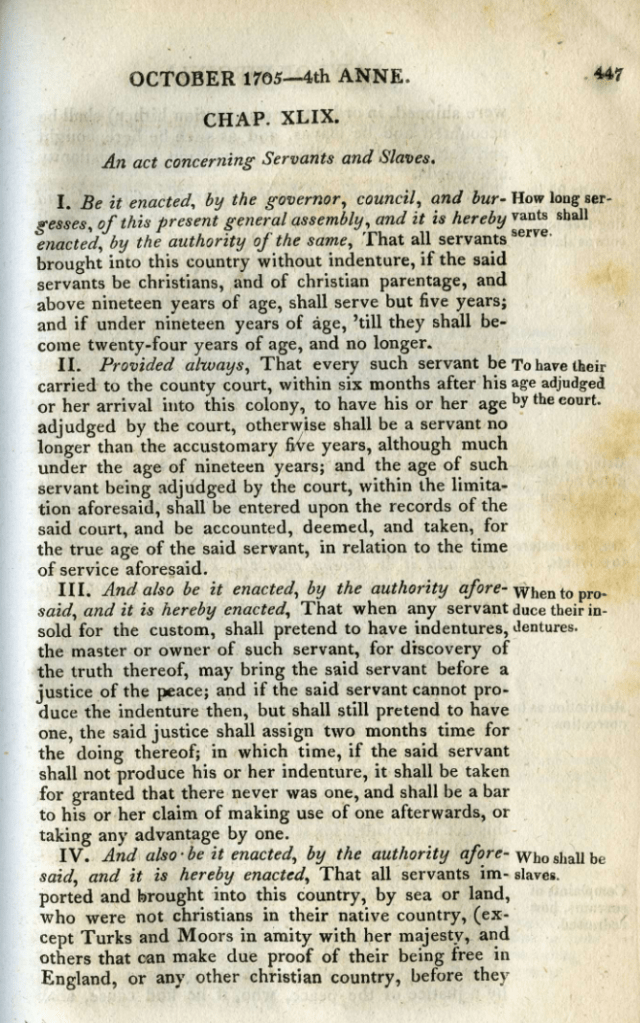
By the early 18th century, Virginia’s economy and society were deeply intertwined with chattel slavery. The Virginia Slave Codes, particularly the comprehensive 1705 code, legally defined enslaved people as property. These laws granted white enslavers and overseers absolute authority over Black bodies, control enforced through violence.
The legal framework prioritized the economic interests of white owners over the lives and rights of the enslaved. This meant that Black people were not recognized as persons with legal protections, but as property to be controlled, even if that control required deadly force.
That Was the “Casual Killing Act”?
The “Casual Killing Act” is a colloquial way to describe how colonial Virginia laws effectively:
- Allowed white people to kill Black people during punishment or “correction” without being charged with felony murder.
- Provided legal immunity for white perpetrators, making it nearly impossible to prosecute or convict them.
- Framed such killings not as criminal acts but as incidents involving “property damage” or accidental outcomes of discipline.
In practice, this meant:
- A white owner or overseer could severely beat an enslaved person or Black child to death and face no criminal charges.
- The most that might happen was paying a fine or compensation for the “loss” of the enslaved person as property.
- White women who disciplined Black children in their households were equally protected under this legal framework.
Legal Foundations in Virginia Slave Codes
The clearest legal foundation comes from the Virginia Slave Codes of 1705, which codified rules governing enslaved people and the rights of their owners.
Key excerpt from the 1705 Virginia Slave Code:
“If any slave shall happen to be killed in the correction of his master or overseer, the master or overseer shall be freed from all punishment for the death of the slave unless it be proven that the killing was done maliciously or willfully beyond what was necessary to correct.”
This clause shows the legal protection granted to white enslavers and overseers who killed enslaved people under the guise of discipline. The law required proof of “malicious” intent beyond “necessary correction” for criminal liability, an almost impossible standard given the social context.
Historian Edmund S. Morgan elaborates in American Slavery, American Freedom (1975):
“The killing of an enslaved person was not treated as murder but as a matter of property damage. The owner might be fined, but this was a civil matter, not a criminal one. The law gave owners the right to ‘correct’ their slaves with violence, including lethal force if deemed necessary.” (Morgan, 1975, p. 91)
Social and Cultural Implications
This legal framework was more than just written laws; it reflected and reinforced the brutal social order:
- White supremacy was maintained by making Black lives legally disposable.
- Violence against Black people was normalized, often publicly accepted as necessary “discipline.”
- The legal system’s protection of white perpetrators sent a clear message: enslaved Black people had no recourse, no justice, no protection.
- The fact that white women were included in this legal immunity means that violence was tolerated even within white households, affecting enslaved children and servants without legal consequence.
Why Does This Matter Today?
Understanding the “Casual Killing Act” as a term for these legal realities is crucial because:
- It exposes the explicit ways in which the law was weaponized to uphold racial violence and oppression.
- It challenges sanitized narratives of colonial history that ignore the systemic brutality enslaved people faced.
- It reveals how early American legal systems established racial violence as a protected practice, a foundation that shaped centuries of racial injustice.
- It’s a reminder that the legal and social systems of the past directly inform present racial disparities and violence.
A Real Example: The Case of Celia, an enslaved person in Missouri (1855)
While outside Virginia, and later, the infamous case of Celia, a Black enslaved woman in Missouri, shows the lasting legacy of these attitudes. Celia was convicted and executed for killing her white owner in self-defense after years of abuse. The court justified the killing as murder, denying her any legal protection, reflecting how the legal system upheld white authority and denied Black people justice. This case echoes the impunity and brutality codified centuries earlier in Virginia.
Conclusion
The so-called “Casual Killing Act” was not a named statute but a reality codified by law and custom in 1700s Virginia. It legally protected white people who beat or killed Black individuals, mainly enslaved people, under the guise of “correction.” This legal immunity was a pillar of the brutal system of chattel slavery, prioritizing white property rights over Black lives.
To confront American history honestly, we must acknowledge these laws and the violent systems they supported. Recognizing this past is essential to understanding the deep roots of racial violence and the ongoing struggle for justice.
Reference:
Virginia General Assembly. (1705). An act concerning servants and enslaved people. Encyclopedia Virginia. Retrieved July 28, 2025, from https://encyclopediavirginia.org/primary-documents/an-act-concerning-servants-and-slaves-1705/
 GANA
GANA 
Leave a comment