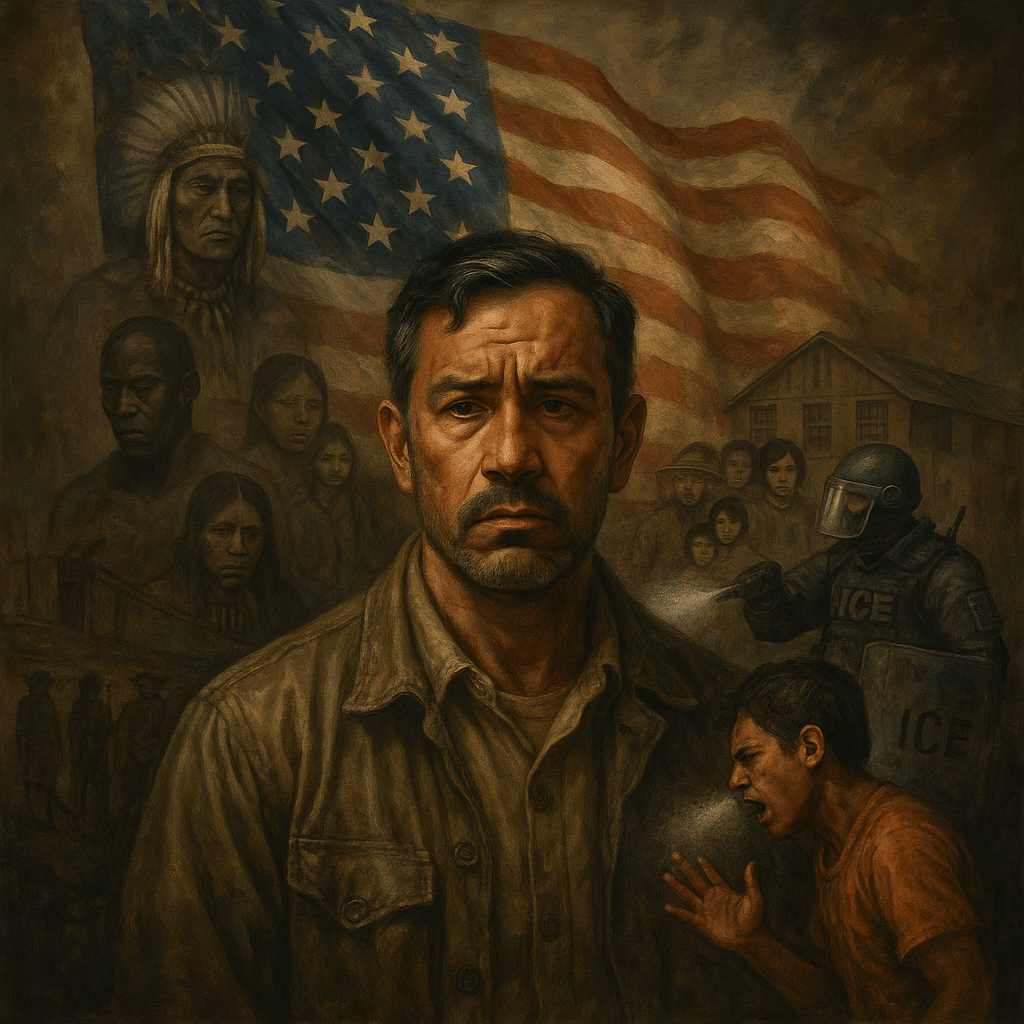
A Personal Pain in Loving This Country
There’s a deep ache in loving a country that so many around you have quietly turned their backs on. I’m proud to be an American who has served, fought, and believed in this nation’s promise of liberty and justice for all. But the silence from people I once called brothers, veterans, neighbors, and friends has been deafening. They go about their lives like nothing is wrong, as if the pain and injustice don’t touch them. That silence? It’s a slap in the face because this country is betraying people like me and my family, again and again.
A History Stained with Broken Promises
America’s story is stained with cycles of broken promises and systemic oppression. Native Americans had their land stolen, cultures crushed, and families torn apart. Forced onto reservations, many endured policies aimed at erasing their identity, including boarding schools where children were stripped of language and heritage. They were used when convenient, like Navajo code talkers in World War II, only to be discarded and neglected afterward. The scars of genocide, forced assimilation, and broken treaties still haunt Native communities today.
Native Hawaiians and the Overthrow of Their Kingdom
The betrayal extends beyond the continental U.S. Native Hawaiians faced the illegal overthrow of their sovereign kingdom in 1893, followed by annexation to the United States without their consent. Their culture, language, and political rights were suppressed in favor of American control. Much like Native Americans on the mainland, Hawaiians were marginalized economically and politically, their sovereignty denied, and their land exploited. The legacy of that colonial seizure still impacts Hawaiians today, as they fight to reclaim their rights and cultural identity.
Alaskan Natives and Colonization
Indigenous peoples of Alaska have similarly endured centuries of colonization and dispossession. From forced relocation and assimilation efforts to environmental degradation caused by resource extraction, Alaskan Natives have had their ancestral lands threatened and their ways of life marginalized. Federal policies often prioritized economic interests over Indigenous rights, creating lasting social and cultural wounds. This is another chapter in the broader story of systemic betrayal faced by Indigenous peoples within the United States and its territories.
African Americans
African Americans were kidnapped, enslaved, and treated as property for centuries. Laws cemented slavery as hereditary and racial, enshrining white supremacy in law. Even after emancipation, systemic racism and violent terrorism, including lynchings, kept Black Americans disenfranchised and in fear. The legacy of slavery informs present-day disparities in justice, housing, education, and economic opportunity.
Japanese Americans
Japanese Americans were imprisoned in internment camps during World War II simply because of their heritage. However, these citizens and patriots, many of whom served with distinction, were branded as enemies. Families lost homes and businesses, and the government’s apology and reparations came decades later, but the trauma remains.
Muslim communities, especially Afghan allies who risked their lives alongside U.S. forces, have been betrayed. Thousands were promised safety, visas, and new lives in the United States. But travel bans, policy changes, and dismantled support systems have left many stranded in limbo, exposed to Taliban rule, abandoned by the country they stood with.
The Myth of Discovery: Calling Out the Theft
One of the most glaring examples of how history is whitewashed is the language we use to describe what happened when Europeans arrived in the Americas. We’re taught they “discovered” this land, as if they stumbled upon empty, unclaimed territory. But let’s be clear: They didn’t discover a damn thing. They stole it.
Indigenous peoples had lived, thrived, and governed these lands for thousands of years before Europeans arrived. To say otherwise is to erase their existence, their civilizations, and the brutal reality of invasion and colonization.
There’s a truth that resonates deeply with many Indigenous and marginalized communities: you can’t be illegal on stolen land. This statement isn’t just a slogan; it’s a powerful indictment of how current laws, borders, and social systems are built upon the original theft of land and rights.
Acknowledging this is not about division, it’s about honesty. It’s about confronting the foundation of the systemic inequalities and betrayals that continue to reverberate through history. If we don’t face this truth, how can we ever break the cycle?
The Modern Cycle Continues
Hispanic communities like mine have endured the same cycle. What started out as a crackdown aimed at illegal immigration, specifically targeting foreign gangs and criminal enterprises, has evolved into widespread raids that go after everyday people. Women, children, fathers, veterans, and contributors to our society and economy are caught up in these sweeps. Their only crime? They didn’t have the right papers.
Labeled with racist slurs like “jungle people” in the past, Hispanic communities are now targeted in sweeping crackdowns. U.S. citizens, children, and veterans alike are swept up simply because they look Hispanic. Just last week, George Retes, a 25-year-old U.S. Army veteran and California native, was pepper-sprayed, had his car window smashed, and detained for three days during an immigration raid. Despite proof of citizenship and service, suspicion based on appearance was enough to treat him like a criminal. No charges. No explanation.
This government’s lack of transparency and growing authoritarianism mean no one is truly safe. If you look Hispanic, you could be dragged away without warning, your rights ignored. The fear is real. Families are torn apart not just by numbers, but also by mothers, fathers, children, and veterans.
What stings most is the silence from those who could stand up. Fellow veterans, neighbors, and coworkers, I thought they were allies. But they live comfortable lives because they don’t have “skin in the game.” Their skin is a different color. They smile politely, but when it comes to standing up, they disappear. That silence isn’t just disappointing, it’s a betrayal.
Honoring Those Who Stand Up And Calling for More
It’s essential to acknowledge that many individuals have spoken out in defense of others across diverse ethnicities, backgrounds, and communities. Their courage and solidarity have saved lives and pushed progress forward. This country is stronger than it often gives itself credit for, filled with individuals and groups who refuse to accept injustice.
But the truth is, it’s not enough. Our society is far more resilient and capable of unity than it often shows. If more of us committed to truly standing up for each other beyond comfort zones, beyond political lines, we wouldn’t still be facing these cycles of betrayal and discrimination.
What is needed now is deep soul-searching. We all carry biases and blind spots shaped by history, culture, and personal experiences. These biases can quietly allow injustice to persist when we look away or remain silent.
If we want to break this cycle, we must honestly acknowledge those biases and intolerances within ourselves and commit to overcoming them. Only then can we build a society where no one has to fear being targeted for who they are, where the promise of liberty and justice truly belongs to all.
Puerto Rico: Citizenship Without Equality
This cycle extends to Puerto Rico, where residents who hold U.S. citizenship face second-class treatment. The century-old Insular Cases Supreme Court rulings continue to deny basic federal benefits to Puerto Ricans, legally codifying discrimination. After a century of American control, Puerto Rico remains a colony with non-voting representation and systemic inequities.
The denial of Supplemental Security Income benefits to the disabled and elderly is just the latest injustice. Meanwhile, Puerto Ricans contribute billions in federal payroll taxes but receive unequal services. This structural inequity is a stain on America’s claim to fairness.
Forgotten Histories: The Mexican Repatriations
Latinos across the U.S. have long suffered brutal exclusion from mob violence and illegal deportations of citizens, to school segregation and economic marginalization. During the Great Depression, up to two million people of Mexican descent were forcibly “repatriated,” many American citizens, torn from their homes and livelihoods. The scars of that forced displacement linger today, yet remain largely forgotten by mainstream America.
Denial and the Need for Honest Education
All these stories aren’t isolated; they’re chapters in the same book of systemic betrayal. America uses marginalized communities when convenient, fighting wars, building economies, enriching culture, and then abandons, criminalizes, or erases them.
Here’s the truth many want to deny: racial discrimination is not a thing of the past. It has evolved but persists in the fabric of our institutions, laws, and everyday interactions.
People want to say, “We’ve moved on,” or accuse Critical Race Theory (CRT) of promoting a victim mentality. But CRT isn’t about victimhood; it’s about illuminating how racism is woven into the very systems that shape society.
Decades, even centuries, of superiority and bias rooted in European colonialism and reinforced here in America have created deep personal and institutional prejudices. These are not just individual attitudes but structural realities that CRT seeks to expose. Without understanding this, we keep repeating the same cycle of injustice over and over.
What Fighting for My Country Means
For me, fighting for my country means fighting for everyone who identifies as American. It means fighting for my land and for every person who lives on it, regardless of race, background, or belief.
I took an oath to uphold and defend the Constitution against all enemies, foreign and domestic; bearing true faith and allegiance to the same. I firmly believe in national security. However, I also deeply believe in humanitarian values, which include protecting human dignity and justice.
When some say they’ll fight for their country, they often mean it only in part. There are people whose allegiance is not to the Constitution or the ideal of America as a land of equal opportunity, but only to their self-interest, or worse, to exclusionary ideas about race or identity.
The creed of the military, the image of the flag, and the honor it represents- these things should never be hijacked for narrow agendas. To do so betrays not only the oath taken by those who serve but the very soul of this country.
True patriotism demands holding fast to the values that unite us and refusing to let symbols be twisted to divide us.
A Call to Reclaim the Soul of This Country
When the soul of this country was forged, it was stormed with murder, theft, and mayhem. That history is in our bones, whether we like to admit it or not.
But it’s also why now it’s time to reclaim the soul of this country. To break the cycle of betrayal. Lawmakers must have the courage to stand independently of party and pressure. Communities must find strength in solidarity and refusal to be invisible.
Every soldier, officer, and Army civilian swears oaths and embraces values that demand more. The Oath of Enlistment commits us to support and defend the Constitution against all enemies, foreign and domestic, bearing true faith and allegiance. The Soldier’s Creed vows never to leave a fallen comrade and to stand as guardians of freedom and the American way of life. The Ranger Creed commits to fighting harder, moving faster, and upholding honor.
The Seven Army Values- Loyalty, Duty, Respect, Selfless Service, Honor, Integrity, and Personal Courage- are not empty words. They form the backbone of service and sacrifice, both on and off the battlefield. Noncommissioned Officers pledge to lead with fairness and moral courage. Army civilians dedicate themselves to leadership, stability, and continuity in all conditions.
These creeds and values represent a sacred promise: to serve something greater than oneself, to protect one another, and to uphold the rights and dignity of every American.
Yet today, where is that courage when families like mine and veterans like George Retes are mistreated? Where is that honor when lawmakers turn a blind eye to abuses? Where is loyalty to the Constitution when centuries-old rulings justify discrimination against whole populations? Where is respect for human dignity when Afghan allies are abandoned to Taliban rule?
Too many who have sworn to uphold these values are silent or complicit. That silence, comfort in inaction, is a betrayal far deeper than any policy failure.
If these ideals mean anything, they demand action. Real courage means standing up for those targeted, even when it’s unpopular. Selfless service means putting the welfare of all before self-interest. Honor and integrity mean defending the Constitution’s promise equally for every American, regardless of race or birthplace.
The future depends on it.
It’s time to reclaim the soul of this country. To break the cycle of betrayal. Lawmakers must have the courage to stand independently of party and pressure. Communities must find strength in solidarity and refusal to be invisible.
Because if we don’t, the cycle will keep spinning, and more families like mine will pay the price every American, regardless of race or birthplace.
The future depends on it.
It’s time to reclaim the soul of this country. To break the cycle of betrayal. Lawmakers must have the courage to stand independently of party and pressure. Communities must find strength in solidarity and refusal to be invisible.
Because if we don’t, the cycle will keep spinning, and more families like mine will pay the price.
 GANA
GANA 
Leave a comment