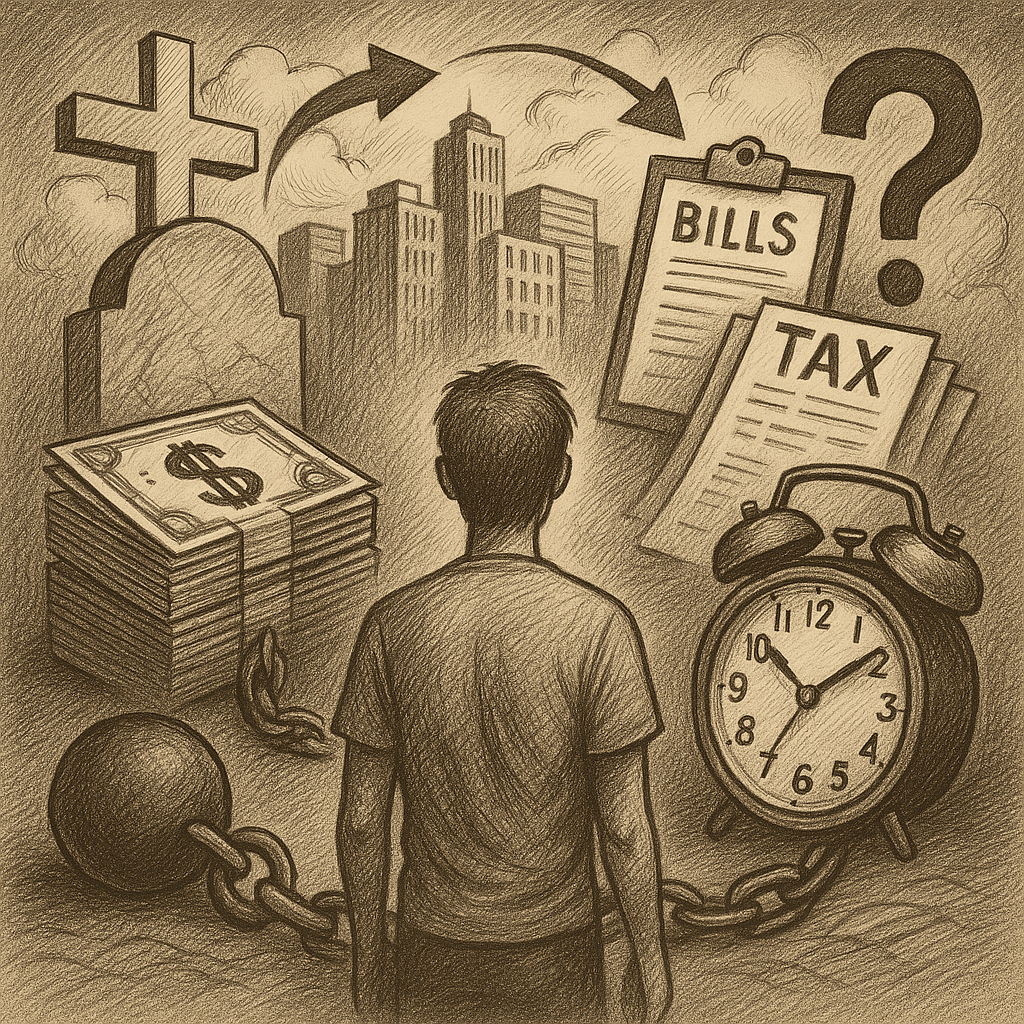
1. Money: The Illusion of Wealth
Money is not wealth. It’s a symbolic tool, paper, or digital numbers, whose value depends entirely on collective belief. Historically, it was backed by gold or tangible assets, but now, most currencies are fiat money: government-issued with no intrinsic value. It works because everyone agrees it works.
Why was money created? To simplify trade and tax collection, while also imposing control. Whoever controls the currency controls economic activity. Banks, governments, and financial institutions use this power to create dependency. They issue debt, control interest rates, and decide who gets access to capital.
If you don’t own the money system, you’re subject to it. Your labor is converted into currency, but that currency can be inflated away, taxed, or restricted. Wealth means assets that hold or increase real value over time, such as land, productive tools, and intellectual property. Money is just the ticket, not the prize.
2. Religion: The Social Contract Tool
Religion isn’t divine magic handed down from the sky. It’s a social institution created by those in power, emperors, kings, and priests, to legitimize authority and control populations.
It provided order, rules, and meaning, yes. But it also enforced obedience by promising rewards (heaven, enlightenment) or threatening punishment (hell, damnation). It shaped morality in a way that kept hierarchical structures stable.
Many religious institutions amassed immense wealth and political influence, acting more like states within states. The deeper you look, the more you see how religion and power often worked hand-in-hand to control minds and behavior, suppress dissent, and channel resources.
3. Taxes, Bills, Rent, and Work: The Economic Cage
Taxes are necessary for any society to function, but the structure and scale of modern taxation often serve to funnel wealth upward or finance systems that sustain elites.
Bills and rent? They lock you into dependence. If you don’t pay, you lose your home, utilities, or services essential to survival. They create a constant pressure to earn money, which leads to work.
Work is the linchpin. Most people are told to get a job, work 40 hours a week, pay taxes, and maybe save for retirement. But work in the capitalist system often means selling your time and energy for a wage set by someone else, rarely tied to the actual value you create.
You’re trapped in a cycle where you work to pay bills, bills to maintain your existence, and taxes to sustain the system. It’s survival, not flourishing.
4. The Conditioning: School, Obedience, and the Scripted Life
From childhood, you’re trained to conform:
- Go to school.
- Sit still.
- Follow instructions.
- Respect authority.
- Aim for a “stable job.”
- Work long hours.
- Retire late, if at all.
This is conditioning for a workforce that emphasizes compliance rather than creativity or freedom. The education system often stifles critical thinking, promotes rote learning, and rewards conformity.
The “script” is a survival manual handed down by generations who accepted the system without question. It’s not designed to maximize your happiness or autonomy; it’s designed to keep the economy and social order running smoothly.
5. The Trap: The Loop of Compliance
The biggest trap is not just the system but the acceptance of the system as “normal” or “the only way.” That loop keeps people locked into:
- Working to pay bills.
- Paying taxes.
- Obeying rules.
- Deferring dreams.
- Expecting freedom later (retirement, vacations).
But “later” rarely comes as expected, health, politics, and economics change. Most never escape the loop. They end up stuck in cycles of debt, dependence, and limited choices.
6. The Breakthrough: Questioning and Building Freedom
The moment you question this setup, you begin to see the cracks and the alternatives.
- You realize money is a tool, not the goal.
- You see religion as one model of community and meaning, not the only one.
- You understand work doesn’t have to mean soul-crushing labor; it can be aligned with purpose and autonomy.
- You recognize taxes and bills as parts of the system, but also as levers to challenge or change the system.
- You start to identify the conditioning and break it.
Absolute freedom isn’t handed out. It’s built. You create it by:
- Educating yourself critically.
- Developing skills to generate independent value.
- Building communities outside traditional power structures.
- Investing in tangible assets, knowledge, and relationships.
- Rejecting the default life script and designing your own.
Bottom line?
The system wasn’t built for you. It was built for control and to sustain existing power dynamics. The sooner you accept that, the sooner you can start building your version of freedom.
No illusions. No excuses. Just honest clarity.
 GANA
GANA 
Leave a comment