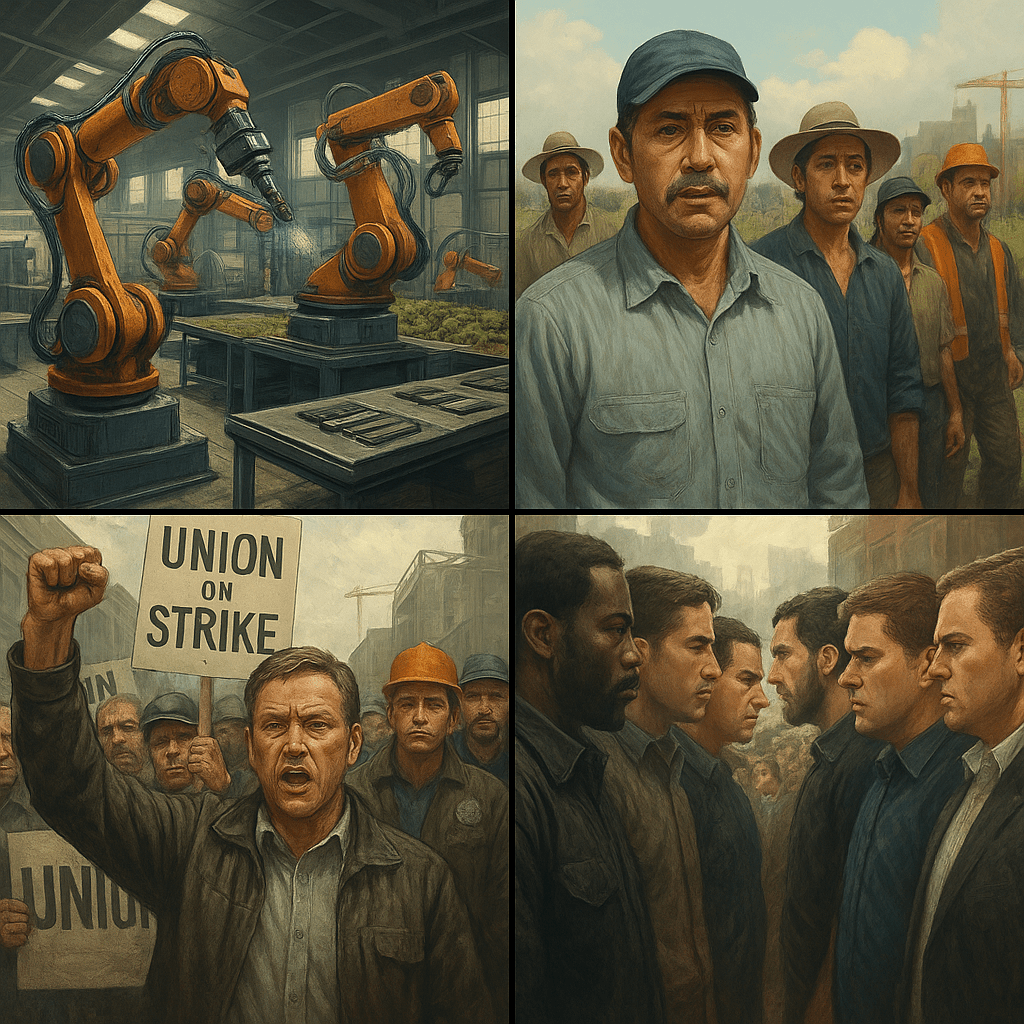
In 2025, the United States faces a glaring contradiction at the heart of its economy and society. Capitalism depends fundamentally on workers who produce goods and services and consumers who buy them. Yet, the very forces capitalism deploys to maximize profits, automation, offshoring, and increasingly brutal immigration policies, are systematically dismantling both pillars. This paradox not only destabilizes the economy but also tears apart communities, erodes solidarity, and fuels divisive tribalism, often inflamed by white nationalist ideologies.
Automation: Efficiency at What Cost?
Automation has been heralded as the path to economic progress for decades, promising increased productivity, lower costs, and technological advancement. Yet, in 2025, the reality is far more complex and troubling.
Robots and artificial intelligence have replaced millions of jobs across manufacturing, logistics, and even services like retail and customer support. Modern factories hum with machines where once stood thousands of workers. For example, automotive assembly plants that used to employ thousands now operate with just a few hundred technicians overseeing robotic arms. Warehouses rely on automated sorting systems that process orders faster than any human workforce.
This relentless drive to automate is a cold calculus of profit. Companies reduce labor costs and increase efficiency to boost margins in a fiercely competitive global market. Yet, the human cost is immense: displaced workers face unemployment or underemployment, often lacking the skills needed for new, technical roles.
Critically, capitalism overlooks the fact that workers are also consumers. As automation displaces jobs and suppresses wages, consumer purchasing power shrinks, threatening demand. The paradox becomes clear: capitalism needs workers to produce, but displaces them to cut costs, thereby undermining its customer base.
The War on Unions: Capitalism’s Frontline Assault on Worker Power
No discussion of capitalism’s paradox in 2025 is complete without addressing the sustained, systematic war on labor unions, the last major bastion of collective worker power. Despite being essential for securing fair wages, workplace protections, and dignity, unions face relentless attacks designed to weaken and dismantle them.
In 2025, union density remains near historic lows, a direct result of decades of corporate lobbying, legal hurdles, and political opposition. The rise of “right-to-work” laws, which allow workers to benefit from union contracts without paying dues, saps unions’ financial strength and organizing capacity. Employers deploy sophisticated anti-union campaigns, using legal loopholes, intimidation tactics, and surveillance to suppress organizing efforts.
Automation and shifting labor markets only compound unions’ challenges. As traditional manufacturing jobs disappear and gig and contract work proliferate, unions struggle to organize increasingly fragmented and precarious workforces.
Politically, while rhetoric occasionally favors workers, actual policies rarely translate into robust protections or support for unions. Regulatory bodies that enforce labor laws are underfunded and ineffective, hindering enforcement.
This war on unions is no accident. It serves capitalism’s imperative to control labor costs, maximize profits, and prevent worker solidarity. Weak unions mean weaker wages, fewer benefits, and diminished political power for the working class, conditions that help maintain the status quo.
Yet the fight to rebuild union power is vital. In 2025, high-profile strikes, innovative organizing in new sectors, and growing public support hint at a possible resurgence. Strengthening unions is essential not only for economic justice but for addressing capitalism’s broader paradox, because empowering workers is the key to balancing the relationship between labor, capital, and society.
Immigration: Essential Yet Under Attack
If automation bites capitalism’s hand by displacing workers, immigration cuts off another crucial artery. Immigrant labor has long been essential to the American economy, filling vital roles in agriculture, construction, hospitality, healthcare, and more. Beyond labor, immigrants contribute as consumers, entrepreneurs, and taxpayers, feeding the very system that now seeks to expel them.
In 2025, however, immigration policy has grown harsher. What began as targeting specific “foreign gangs” years ago has escalated into mass deportations and restrictive laws aimed broadly at anyone who “doesn’t look American.” Families, many of whom have contributed to communities and the economy for years, face separation and legal limbo. The process for legal immigration has become prohibitively difficult, limiting the ability of new workers to enter and contribute.
This attack on immigrants directly contradicts capitalism’s dependence on cheap, flexible labor. Deporting millions, cracking down on legal pathways, and fostering fear and suspicion destabilize industries that rely on immigrant workers. Farms go unharvested, care facilities suffer shortages, and small businesses struggle to fill roles.
Moreover, immigrants are consumers who sustain local economies. Removing them shrinks demand further, deepening economic contraction in vulnerable regions.
Tribalism and White Nationalism: Divide to Rule
To mask and manage these contradictions, capitalism leverages tribalism as a deliberate strategy to divide and distract.
In 2025, political rhetoric frequently pits “us” against “them,” framing immigrants and minorities as scapegoats for economic hardship. White nationalist ideologies gain ground by amplifying fears about culture, jobs, and security. Media and social platforms, driven by outrage and algorithms, amplify these divisions, creating echo chambers of suspicion and hostility.
This tribalism fractures worker solidarity and community cohesion. When the working class is divided by race, ethnicity, or immigration status, unified economic demands become impossible. The ultimate beneficiary of this division is capitalism itself, which preserves profits by keeping labor fragmented and powerless.
The Loss of Humanity in Pursuit of Profit
Capitalism’s relentless drive for profit leaves little room for humanity or compassion. Automation, offshoring, and aggressive immigration enforcement are justified as economic necessities, but the social costs are immense.
Families are separated, communities destabilized, and millions of workers disenfranchised. The erosion of economic security breeds despair, political polarization, and social unrest. Mental health crises rise as hope diminishes.
Environmental disasters worsened by climate change hit marginalized communities hardest, compounding injustice. Meanwhile, authoritarian tendencies grow, exploiting division to weaken democratic institutions.
The Broader Economic Impact: Inequality and Precarity
The economic impacts of these trends are stark:
- Real wages for most Americans have stagnated or declined after inflation adjustments.
- The wealthiest 1% hold a disproportionate share of assets.
- Job insecurity grows as gig, contract, and part-time work replace stable employment.
- Social safety nets lag behind the scale of displacement and poverty.
Consumers tighten their belts, shifting spending toward discount and secondhand markets. Credit card debt balloons as families struggle to cover basics. These trends undermine economic growth and social stability.
What Can Be Done: Toward Solidarity and Justice
Addressing these crises requires confronting the paradox head-on:
- Build solidarity that crosses racial, ethnic, and political lines to unify workers and communities.
- Redefine economic success to prioritize equity, well-being, and sustainability rather than endless growth.
- Guarantee economic security through universal basic income, expanded wage supports, universal healthcare, and robust social safety nets.
- Tax automation and wealth to fairly redistribute gains from increased productivity.
- Reform immigration policies with dignity and economic reality, recognizing immigrants’ critical role.
- Invest in education and retraining accessible to all, not just tech elites, to prepare workers for the future economy.
Conclusion: The Choice Before Us
The paradox of capitalism in 2025 forces a choice: continue down a path where automation and xenophobia hollow out our economy and society, or build a future grounded in justice, solidarity, and shared prosperity.
The attacks on immigrants, escalating from fears of gangs to broad racial profiling, are a cynical distraction from capitalism’s more profound contradictions. The working class must reject division and unite to demand an economy that puts people before profits.
How we respond will define America’s social and economic future for decades to come.
 GANA
GANA 
Leave a comment