Recently, I came across a short but striking video featuring two space aliens discussing the staggering fact that Earth is $315 trillion in debt. Their conversation is both hilarious and bewildering, highlighting the absurdity of a planet so rich in resources yet drowning in debt.
Here’s the transcript of their exchange so you can see for yourself:
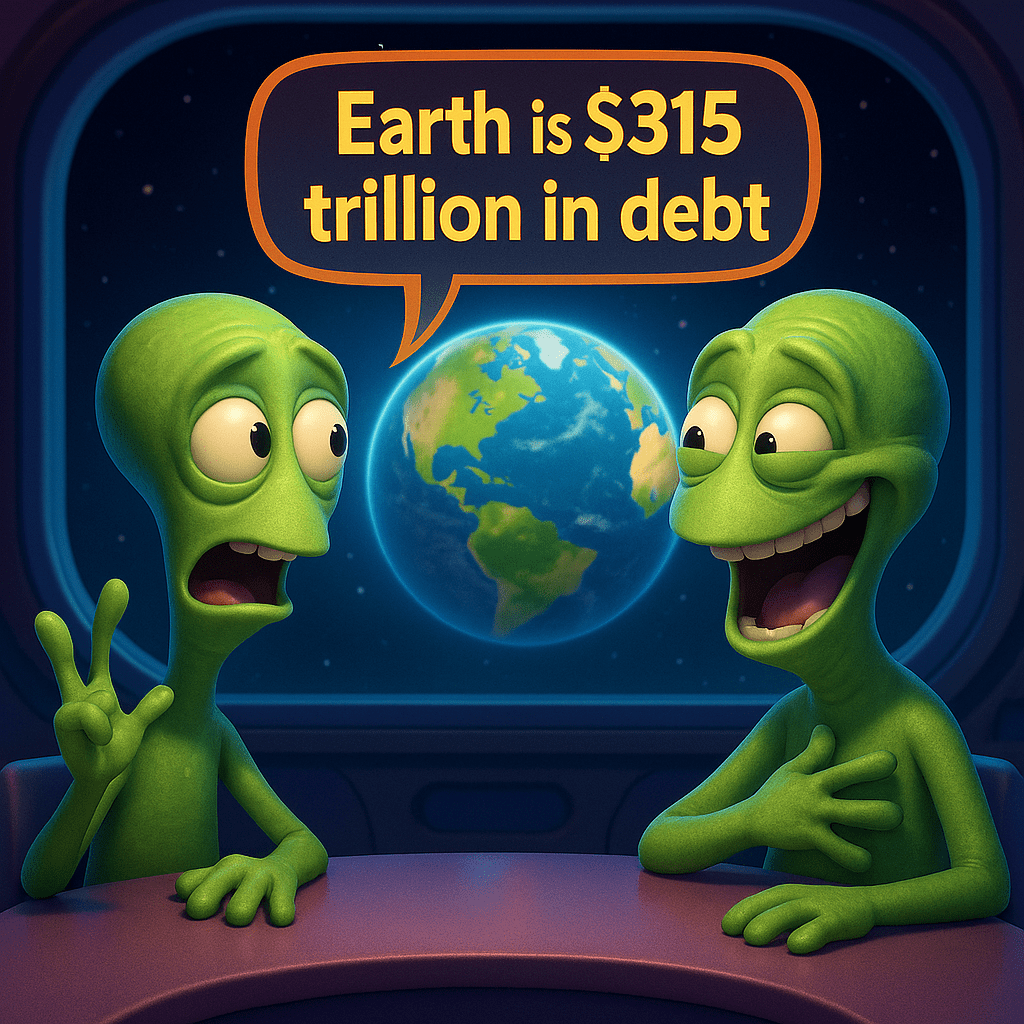
Alien 1: “Did you see the latest report? Earth is $315 trillion in debt. Three hundred and fifteen trillion!”
Alien 2: “What? Who do they owe that to? And who’s giving them money? It blows my mind.”
Alien 1: “Right? They have everything they need—air, water, food, resources—all naturally available. And yet, they created a system that makes them poorer every day.”
Alien 2: “Yeah, they invented money as a store of value, but it’s like storing air in a leaky balloon. It continues to lose value as they build more technology and ‘progress.’ How do you owe $315 trillion when you’ve got all the resources around you for free?”
Alien 1: “Exactly! And get this — there’s not even enough paper on the whole planet to print that much money. It’s all just numbers in computers.”
Alien 2: “Ha! Earth is the biggest meme coin in the galaxy. No real backing, just endless IOUs to themselves.”
Alien 1: “They’re basically bankrupt in their own currency but still acting like they’re rich. It’s hilarious and tragic all at once.”
Alien 2: “Seriously, if we ever invest, Earth’s debt is the ultimate joke token. The worst meme coin ever.”
The aliens’ laughter captures a shared disbelief that is easy to understand. At first glance, $315 trillion in debt sounds so outrageous it almost seems like a cosmic joke. How can a planet overflowing with natural wealth owe such an unfathomable sum? And when most currency exists as digital entries rather than physical cash, what does it really mean to owe this much?
But here’s the reality: While the video is funny, the truth behind this massive debt is far darker and more complex. It reveals a fundamental contradiction in how humans organize their economies—a system where abstract financial obligations often overshadow real resources, and where debt grows faster than true wealth or sustainability.
In the rest of this article, we’ll explore what this debt means for Earth’s future—and what lessons Ghana—and the world—can draw from it.
Source: Visual Capitalist, “Charted: $315 Trillion in Global Debt, by Sector,” May 2024.
The Core Issue: Earth’s Massive Debt and Economic Paradox
- $315 Trillion Debt
This number reflects the staggering scale of global debt, combining public and private liabilities. It far exceeds the total annual economic output (GDP) of the entire planet, raising urgent questions about economic sustainability and structure. - Who Owes and Who Owns?
Debt spans governments, corporations, individuals, and financial institutions. Often, creditors lend to one another or hold complex debt instruments, making it difficult to track the proper flow of value and power. - Paradox of Abundance vs Debt
Earth has abundant natural resources, air, water, minerals, and food, which theoretically should sustain life and wealth without cost. Yet, humans have created financial systems that separate value from these resources, resulting in debt disconnected from physical reality. - Money as a Deteriorating Store of Value
Currencies lose purchasing power over time due to inflation and systemic instability. Despite advances in technology and productivity, the value held in money depreciates, undermining trust in the financial system. - Technology Growth vs Financial Obligations
Technological progress should ideally reduce costs and create wealth. Instead, rising debt suggests economic growth is not translating into true solvency or sustainable resource use. - Fiat Money and Its Limitations
The lack of physical cash to “print” the debt highlights that modern economies rely on digital money, numbers in databases, rather than tangible assets. Money is a social contract, not a direct representation of material wealth. - Systemic Risks and Sustainability
The current system depends on continuous growth, credit expansion, and confidence. When debt grows faster than real wealth or resources, the system risks collapse or long-term crises. - Metaphor of the “Worst Meme Coin”
Calling Earth’s economy the “worst meme coin” sharply captures its speculative nature—an asset with no intrinsic value, driven by perception rather than fundamentals, and vulnerable to bubbles and crashes. It highlights fragility and disconnection from real value.
Privilege, Behavior, and the Economic Game
The staggering $315 trillion debt isn’t just about numbers or resources. It’s also about how economic privilege changes human behavior and how that behavior sustains inequality.
In social psychology experiments led by Dr. Paul Piff at UC Berkeley, participants played Monopoly with uneven rules: some got more money, better rolls, and extra turns. The “privileged” players quickly became more entitled, boastful, and less empathetic, despite the advantage being totally arbitrary.
This experiment reveals a critical truth: privilege rewires attitudes and behavior, making those who benefit feel entitled and others less deserving. In a way, this mirrors our global economic system. Those controlling wealth and financial power behave like the “rich” Monopoly players, often disconnected from real resource wealth and less concerned about those left behind.
The alien conversation about Earth being the “worst meme coin” isn’t just about absurd debt; it’s about how our system rewards privilege and perpetuates inequality, even when the advantages are artificial or unsustainable. Understanding this human side is essential if we want to imagine a fairer, more sustainable economic future for Ghana and the world.
Summary
This message is a critique of the modern global economic system. It points to a fundamental contradiction:
- Humans inhabit a planet rich in natural resources that can sustain abundant life.
- Yet, the financial system is built on abstract concepts of value, money, and debt that often increase independently of, or in opposition to, actual resource availability.
- This contradiction leads to unsustainable debt levels, eroding trust, and systemic instability, despite technological progress.
This reality calls for a deep reflection on how value is defined, stored, and exchanged, as well as whether current economic models truly serve the long-term well-being of our planet and its people.
 GANA
GANA 
Leave a comment