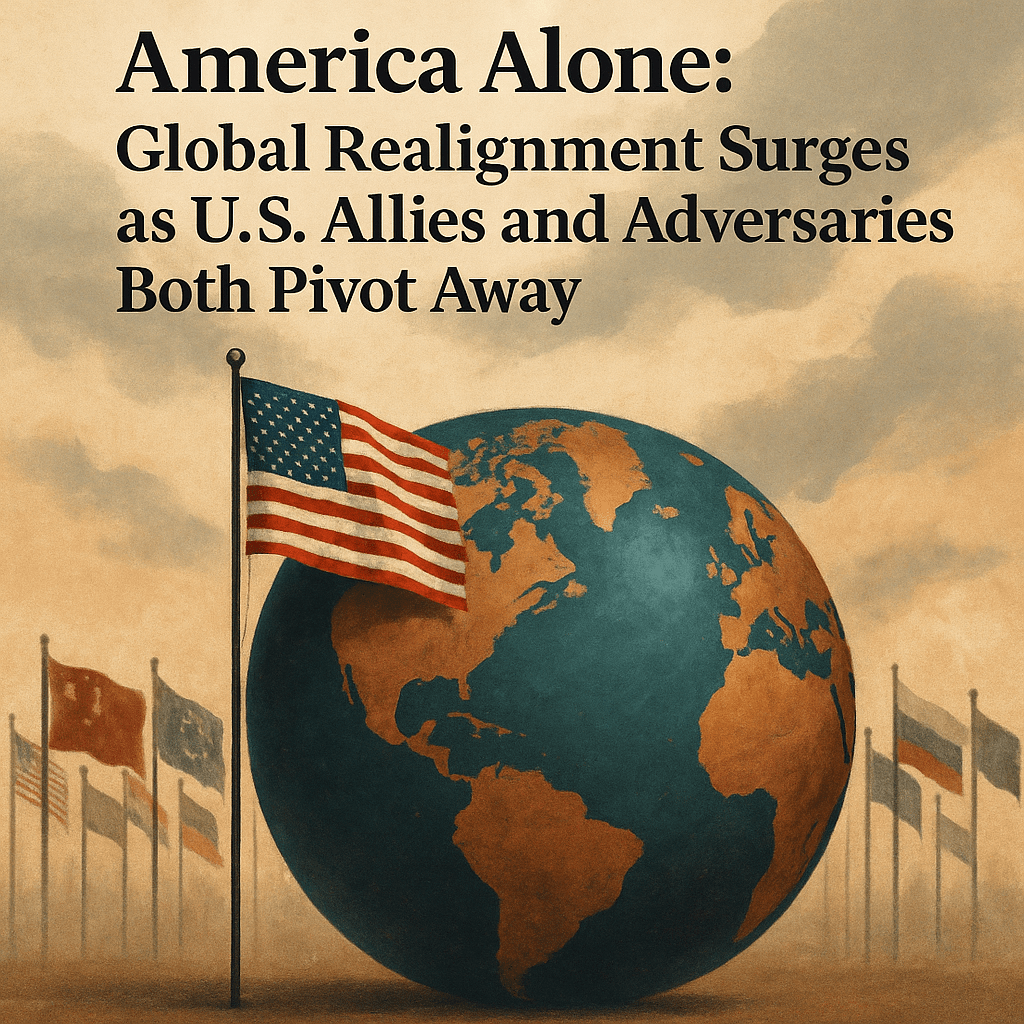
Less than three months into President Donald J. Trump’s second term, the global balance of power is undergoing a visible and significant realignment. Allies are re-evaluating defense and economic partnerships, while strategic competitors are forging deeper alliances. The catalyst: an increasingly unilateral U.S. foreign policy shaped by across-the-board tariffs, transactional diplomacy, and disengagement from longstanding multilateral commitments. As a result, Washington is no longer broadly viewed as the consistent leader of the post-war international order.
“We must build our capacity to act. We cannot rely exclusively on others, even our closest ally, the United States.”
— Josep Borrell, EU High Representative for Foreign Affairs
(February 2025, EU Strategic Autonomy Forum)
Europe Pursues Strategic Autonomy
At the heart of the shift is growing unease among NATO member states. President Trump’s recent call for defense spending increases to 5% of GDP—more than double NATO’s 2% benchmark—has drawn criticism from several European leaders, who view the move as part of a broader pattern of pressure-based diplomacy. A January 2025 European Council on Foreign Relations poll found growing support for a European defense union independent of U.S. guarantees.
French President Emmanuel Macron and German Chancellor Olaf Scholz have renewed their push for “strategic autonomy,” while talks of a rapid deployment force under EU command are advancing. Simultaneously, quiet discussions regarding potential NATO restructuring—including the symbolic position of Supreme Allied Commander Europe—underscore growing uncertainty about American leadership in the alliance.
Global Trade Tensions Escalate Following Universal Tariff Policy
On April 2, President Trump proclaimed “Liberation Day,” announcing a universal 10% tariff on all imported goods, effective April 5. In response, over 50 nations are preparing reciprocal tariffs—some up to 50%—scheduled to begin April 9. Although a few U.S. allies received exemptions, the global reaction has been swift and far-reaching.
- China announced potential countermeasures, signaling possible coordination with South Korea and Japan.
- The European Commission invoked its Anti-Coercion Instrument to prepare retaliatory tariffs.
- Australia and New Zealand issued joint statements of concern and initiated diplomatic consultations.
According to the Center for Strategic and International Studies (CSIS), the tariff policy could raise U.S. consumer prices by nearly 10% and decrease GDP by approximately 1%, reducing household purchasing power. As Politico EU noted, “Trump has not just triggered trade retaliation—he’s cost America the world.” Global markets have already reacted, with the Dow and European exchanges experiencing sharp corrections.
North America Reassesses Economic and Security Ties
President Trump’s statements about potential tariffs on Canadian and Mexican imports—and controversial remarks about possible annexation scenarios—have led to a reconsideration of North America’s strategic cohesion.
Canadian Prime Minister Mark Carney declared that “the era of deepening U.S.-Canada integration has ended,” prompting new domestic energy initiatives, reevaluation of military partnerships, and potential changes in the Five Eyes intelligence framework.
Mexico, under President Claudia Sheinbaum, has taken a dual-track approach—engaging quietly with U.S. security demands while rapidly expanding trade ties with Europe and Asia. A modernized EU-Mexico trade agreement, concluded in early 2025, aims to reduce reliance on the U.S.-centered NAFTA and USMCA frameworks.
Strategic Rivals Deepen Ties
As the U.S. focuses inward, countries such as China, Russia, and Iran are increasing coordination:
- The Shanghai Cooperation Organization has added Iran as a full member and is emphasizing joint military and economic efforts.
- China continues to expand Belt and Road initiatives across Latin America and Sub-Saharan Africa.
- Russia and Iran are bolstering intelligence and energy alliances.
- A BRICS-backed digital currency is in development to reduce dependence on the U.S. dollar.
While these developments reflect longstanding geopolitical trends, the current moment appears to be accelerating their pace. What was once a speculative alternative order is now an active coordination among states seeking to navigate a multipolar world.
Taiwan Faces Strategic Ambiguity
In East Asia, Taiwan remains in a delicate position. The administration’s fluctuating statements regarding military support and proposed tariffs on semiconductors have heightened concerns. Taipei has increased both defense spending and civil preparedness, yet uncertainty remains regarding potential U.S. intervention in the event of Chinese aggression.
Taiwan’s role in global semiconductor supply—particularly through TSMC—has become both a strategic asset and a geopolitical fault line in the broader U.S.-China rivalry.
Diverging Global Strategies: Reindustrialization vs. Retrenchment
Supporters of the administration’s policies argue that tariffs and deal-based diplomacy are necessary to protect American workers and regain economic leverage. However, economists and foreign policy analysts increasingly warn that isolation may yield more strategic costs than benefits.
- Allies are reevaluating decades-old relationships.
- Competitor blocs are gaining ground diplomatically and economically.
- Markets are responding with volatility, not confidence.
Even among those sympathetic to the goal of reindustrialization, many caution that tariffs alone cannot offset decades of automation, offshoring, and global economic transformation. What some describe as rebalancing, others interpret as withdrawal.
“This isn’t reindustrialization—it’s strategic isolation,” noted one economist in response to ongoing market instability.
Conclusion: A Moment of Transition, or Long-Term Decline?
The global perception of the United States is evolving. A combination of unilateral trade measures, shifting alliance dynamics, and foreign policy recalibration has prompted allies and adversaries alike to rethink their approach to Washington.
Whether this period represents a strategic recalibration or a more enduring reduction in U.S. global influence remains to be seen. What is evident, however, is that the 21st-century world order is in flux—and the United States may no longer be its uncontested architect.

 GANA
GANA 
Leave a comment